• Security incident: ISF was recently accessed by intruders. Please change your password, and change it anywhere else you used it. Read more

Global warming discussion IV

Status
Not open for further replies.
The thermohaline circulation has being "upplayed" in all these analysis of a warming world. The themohaline circulation is the ultimate evidence of how intricate and delicate equilibrium is. Now that we have kicked the chessboard, stertors and the occasional convulsion are to be expected.

Well, for most of modern history (as short as that epoch is) we have seemingly had a very regular and steady global thermohaline circulation pattern. However, as much of my climate understanding and focus is devoted to, and derived from, paleoclimate research, this has not always been the case. It is probably rare to completely lose all thermohaline circulation, but the disruption of global circulation patterns appears to rather frequently (over longer timeframes) degrade to focus more around the system of local and regional circulation systems that seem to isolate themselves somewhat from each other and aren't near as efficient or effective at global transfer and dispersal of heat energy. These don't tend to be long-term stable, but they can cause a lot of biosystem disruption while they exist.

I'm seeing in those graphics the SH increasingly ditching surplus heat, as the mixed layer in the Southern Ocean can reach dephs up to 650m during Winter and the combination of sea ice creation with their brine columns sinking, the strong winds with 20 to 30 feet waves everywhere every time, and the continuous arrival of temperate water by means of Brazil, Mozambique and East Australia currents makes the region a food processor in a planetary scale...

That wind trend is curious as well, are you talking about tropical or sub tropical winds, or the far southern seas? Are we seeing a strengthening of the polar gyres which are driving these winds, or, in your opinion, is this a consequence of some other factor? There was a lot more talk of this back at the beginning of the decade (2010-2011).

Denialists centred on the "pause" just to drive attention away from the massive developments in the climate system. They earned 15 years for their lobbying patrons (and many of them did it for free! how stupid can they be?). The only consolation is there are now many candidates repeating the stupid bits, but the money is no longer coming to them.

That's public policy (AKA politics), and to be quite frank with you, I've given up hope for successful, substantive AGW action. I'm just still intrigued by the science and as long as I can keep myself distracted with the science, I don't have to spend all my time grieving for the unnecessary loss of life, waste of national resources and damage to the planet's biosystem that is the result of our own short-sighted ignorance and arrogance.
 
Last edited:
That wind trend is curious as well, are you talking about tropical or sub tropical winds, or the far southern seas? Are we seeing a strengthening of the polar gyres which are driving these winds, or, in your opinion, is this a consequence of some other factor? There was a lot more talk of this back at the beginning of the decade (2010-2011).

I was talking -forgive me I was not clear about it- of the regions between 35 and 70°S. The specific regions I nicknamed "the hub" that are noticeable in this map

picture.php


covering the area of the southern oceans that is coloured greenish or turquoise but not straight blue, and all the yellowish and orangesh adjacent areas up to 1000 km North of the zones of maximum horizontal gradient.

The deep mixed layer and the sustained winter winds are mainly around 50 to 65°S.

Single trees grow this way in Southern Patagonia (the camera is pointing to the Southern Pole so the sun is on the back)

2hx1xky.jpg


[I'll get back to you later on this and the rest of topics you mentioned]
 
I was talking -forgive me I was not clear about it- of the regions between 35 and 70°S. The specific regions I nicknamed "the hub" that are noticeable in this map...

[I'll get back to you later on this and the rest of topics you mentioned]

Much clearer now, Thank-you!

Don't worry about the rest I was just rambling on mostly, but I'm usually interested in any considerations you might have.
 
Much clearer now, Thank-you!

You're quite welcome. The following link may be interesting to illustrate the waves I was talking about. At the time of posting this message, within the green circle, wave heigh peak is 8.12m (27feet)

https://earth.nullschool.net/#curre...ographic=-4.05,-43.27,162/loc=-89.019,-42.489

EDIT: Take into account that winter conditions make the sea surface temperatures to be similar to those at 300 or 700m depths, so it's easy for sea water to mix at all levels. By exploring other areas in the NH you may find waves up to 18 feet now, but summer conditions make the surface temperature to be several degrees higher than that at -500m, hence water mixture is prevented and the mixed layer is just a few tens of metres.

Those conditions will reverse 6 months in the future, but high latitude oceans are much smaller and isolated in the NH, besides sea ice there occupies the whole basin and prevents a lot of fringe action. There's no machinery like the Southernmost Ocean to channel heat to different ocean depths. And that's not just "local pride":D.
 
Last edited:
You're quite welcome. The following link may be interesting to illustrate the waves I was talking about. At the time of posting this message, within the green circle, wave heigh peak is 8.12m (27feet)

https://earth.nullschool.net/#curre...ographic=-4.05,-43.27,162/loc=-89.019,-42.489

EDIT: Take into account that winter conditions make the sea surface temperatures to be similar to those at 300 or 700m depths, so it's easy for sea water to mix at all levels. By exploring other areas in the NH you may find waves up to 18 feet now, but summer conditions make the surface temperature to be several degrees higher than that at -500m, hence water mixture is prevented and the mixed layer is just a few tens of metres.

Those conditions will reverse 6 months in the future, but high latitude oceans are much smaller and isolated in the NH, besides sea ice there occupies the whole basin and prevents a lot of fringe action. There's no machinery like the Southernmost Ocean to channel heat to different ocean depths. And that's not just "local pride":D.

Perfectly reasonable and sound from where I'm sitting!
 
Well, for most of modern history (as short as that epoch is) we have seemingly had a very regular and steady global thermohaline circulation pattern. However, as much of my climate understanding and focus is devoted to, and derived from, paleoclimate research, this has not always been the case. It is probably rare to completely lose all thermohaline circulation, but the disruption of global circulation patterns appears to rather frequently (over longer timeframes) degrade to focus more around the system of local and regional circulation systems that seem to isolate themselves somewhat from each other and aren't near as efficient or effective at global transfer and dispersal of heat energy. These don't tend to be long-term stable, but they can cause a lot of biosystem disruption while they exist.

Yes, tropical biosystems are quite fragile with this events (today I was remembering the banned Texan coot that used to say here that corals bleached as a preventive action and that they know what they were doing). But thermohaline circulation is far from danger these days. When I think of it I can't help to compare it with portal hypertension and how the flow must go on no matter the extraordinary stress on other parts of the system.

That's public policy (AKA politics), and to be quite frank with you, I've given up hope for successful, substantive AGW action. I'm just still intrigued by the science and as long as I can keep myself distracted with the science, I don't have to spend all my time grieving for the unnecessary loss of life, waste of national resources and damage to the planet's biosystem that is the result of our own short-sighted ignorance and arrogance.

My bet is on tariffs on countries emissions that could solve the problem in little more than one generation. It only could be kick off by the EU, and maybe with the contribution of Mercosur it would be easier. But both country blocks are now facing centrifuge forces, so they hardly are to allow themselves political tension with China and the USA, and a little less with Russia and India (I have to say that TrumPotus would make this much easier to achieve)
 
Yes, tropical biosystems are quite fragile with this events (today I was remembering the banned Texan coot that used to say here that corals bleached as a preventive action and that they know what they were doing). But thermohaline circulation is far from danger these days. When I think of it I can't help to compare it with portal hypertension and how the flow must go on no matter the extraordinary stress on other parts of the system.

Actually, I think that is a remarkably cogent analogy! I may borrow it, if you don't mind.

My bet is on tariffs on countries emissions that could solve the problem in little more than one generation. It only could be kick off by the EU, and maybe with the contribution of Mercosur it would be easier. But both country blocks are now facing centrifuge forces, so they hardly are to allow themselves political tension with China and the USA, and a little less with Russia and India (I have to say that TrumPotus would make this much easier to achieve)

I agree with your inclinations and assessments, though I see little chance that the US moves to carbon tariffs, much less substantive carbon tariffs anytime soon, but I don't want to discuss policy here. The powers that be have been particularly persnickety about that here lately, and with the politics threads here being as virulent as they've been during this US election season, the last thing we want to do is infuse that venom here. It has actually been rather peaceful here lately.
 
Last edited:
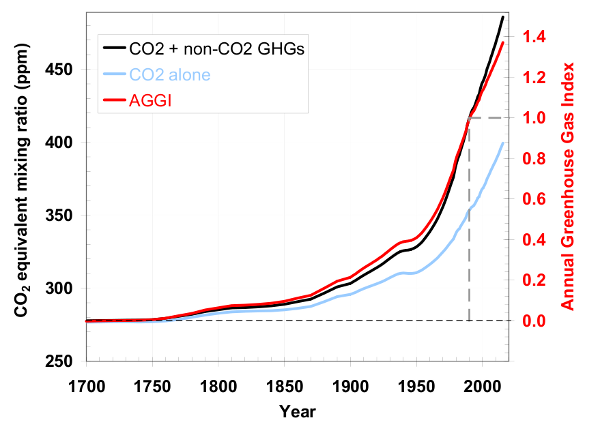
are we fooling ourselves completely by not counting the full GHG emission spectrum???

CO2e a more encompassing look...


Smashing Through 490 — Fragmenting Prospects for Avoiding 2 C Warming
“The IPCC indicated in its fourth assessment report that achieving a 2 C target would mean stabilizing greenhouse gas concentrations in the atmosphere at around 445 to 490 ppm CO2 equivalent or lower. Higher levels would substantially increase the risks of harmful and irreversible climate change.” –Johan Eliasch

NOAA's Greenhouse Gas Index

noaas-greenhouse-gas-index.png


(NOAA’s greenhouse gas index shows that CO2e concentration for 2015 averaged 485 ppm. Given recent rates of rise, the 2016 average should be near 490 ppm CO2e. At the latest, this key threshold will be crossed some time during 2017. Image source: NOAA’s Earth Systems Research Laboratory.)

*****

There are a few things we know about climate change that should really keep us up at night. The first is that the world is warming, and this warming of the Earth, in so many ways, is dangerous to human beings and all the other innocent creatures living here.

The second is that, over recent years, this warming has been very rapid. In the three years from 2014 through 2016, the Earth’s atmospheric temperature is likely to have increased by 0.2 degrees Celsius or more to around 1.2 C above 1880s levels. When thinking about this in absolute terms, it doesn’t sound like much. But in geological terms, this is very rapid warming, especially when you consider that, at the end of the last ice age, it took about 400 years to produce a similar amount of atmospheric temperature gain.

What all this boils down to is that as global temperatures have spiked, we’ve rapidly crossed an established climate threshold into a far more geophysically dangerous time.

Surging Levels of Heat-Trapping Gasses

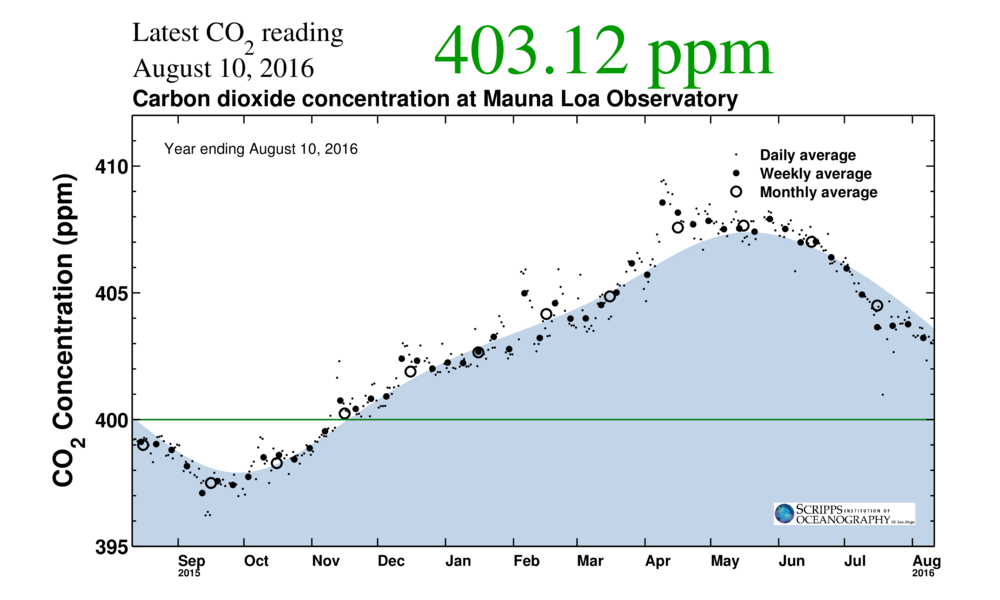
405 parts per million carbon dioxide. That’s about the average level of CO2 accumulation the Earth’s atmosphere will see by the end of 2016, due primarily to fossil-fuel burning. It’s a big number. The Earth hasn’t seen a number like that in millions of years. But 405 ppm CO2 doesn’t tell the whole story of heat-trapping gasses in the atmosphere. To do that, we have to look at another number — carbon dioxide equivalent or CO2e.

The Keeling Curve August
the-keeling-curve-august.png


(During a typical September and October, daily or weekly values may briefly dip below 400 ppm CO2, as detected at the Mauna Loa Observatory. But after September-October 2016, it’s unlikely that you or I will ever see such low levels of CO2 from that measure again in our lifetimes. Image source: Scripps Institution of Oceanography.)

490 ppm CO2e. That’s about the total amount of CO2-equivalent heat forcing from all the human-added greenhouse gasses like CO2, methane, various nitrogen compounds, and other gaseous chemical waste that the Earth’s atmosphere will see by late 2016 to early 2017.

Why is this a big deal?

Four reasons —

First, hitting 490 CO2e crosses the Intergovernmental Panel on Climate Change‘s (IPCC) lowest climate threshold. If this were a highway, and climate change were a collision, we’d now be careening through the first guardrail.

Second, 490 CO2e represents significant current and future warming (and there’s good reason to believe that IPCC’s estimates of that warming may be a bit conservative).

Third, it signifies that we have now fully entered the era of catastrophic climate change, with some bad climate outcomes almost certainly locked in as a result. We see a number of these instances now in the form of extreme rainfall events, extreme drought, coral bleaching, sea ice and glacial melt, threatened crops, ocean anoxia and dead zones, widespread harmful algae blooms, ocean acidification, and expanding infectious disease ranges. However, what we are experiencing now is just the tip of the (melting) climate change iceberg if we do not rapidly respond.

Fourth, if we were never really aware before that we very urgently need to get serious about swiftly cutting fossil-fuel emissions, protecting and regrowing forests, and working to help people to adapt to climate change, then this is our wake-up call.

more

https://robertscribbler.com/2016/08...agmenting-prospects-for-avoiding-2-c-warming/
 
are we fooling ourselves completely by not counting the full GHG emission spectrum???

CO2e a more encompassing look...

more

https://robertscribbler.com/2016/08...agmenting-prospects-for-avoiding-2-c-warming/

Interesting. Largely in accord with much of my current understandings and the reason for my increased despondency with regard to adequately addressing AGW and its requisite public policy changes.

This was re-enforced a few months back when I was discussing these issues with some of the researchers I regularly communicate with and they directed me to some preprints of studies which should soon be appearing in publication. The first ones dealt with the 1.5C limit (which I wasn't too surprised about as we are already pushing ~1.3C Above Pre-Industrial). It was the 2.0C limit assessments which depressed me. We are well beyond being able to easily and casually stay below 2.0C. The calculations I saw indicated that in order to stay below 2.0C we would have to globally eliminate using coal for power generation within the next 5 years, and eliminate all fossil-fueled internal combustion engines by 2030 (~13.5 years). As I mentioned before, I don't want to get into policy discussions in this thread, but I don't see any way that America, much less the world, is politically capable of doing this, and the longer things keep going as they are going, the worse the situation gets.

I now fear that we'll be lucky if we can hold maximum increases to 6.0C and even that will probably involve "overshoot and collapse/draw-back" and require severe economic restrictions and other even more draconian measures to achieve. Perhaps we do need a new thread to discuss where we are at, where we are headed and policies to avoid or deal with these consequences, though I am loathe to move such a discussion into the politics threads. Perhaps if it is in the Non-USA & General Politics thread? Is there a way to address this within the science and technology board without devolving into partisan political squabbles?
 
“Climate urgency: we've locked in more global warming than people realize” - https://www.theguardian.com/environ...ed-in-more-global-warming-than-people-realize
While most people accept the reality of human-caused global warming, we tend not to view it as an urgent issue or high priority. That lack of immediate concern may in part stem from a lack of understanding that today’s pollution will heat the planet for centuries to come…
So far humans have caused about 1°C warming of global surface temperatures, but if we were to freeze the level of atmospheric carbon dioxide at today’s levels, the planet would continue warming…The Earth’s surface would keep warming about another 1.5°C over the ensuing centuries…
We don’t know what technologies will be available in the future, but we do know that the more carbon pollution we pump into the atmosphere today, the longer it will take and more difficult it will be to reach zero emissions and stabilize the climate. We’ll also have to pull that much more carbon out of the atmosphere.
It’s possible that as in three of the IPCC scenarios, we’ll never get all the way down to zero or negative carbon emissions, in which case today’s pollution will keep heating the planet for centuries to come. Today’s carbon pollution will leave a legacy of climate change consequences that future generations may struggle with for the next thousand years…

picture.php
…

Provided we survive our short-sighted, all too often arrogant, ignorance.

This article brings up several climate science issues that are too frequently completely left out of the popular media discussion of climate science and anthropogenic global warming. All too frequently the slower long-term persistence of fossil carbon in the environment and full climate equilibration to this carbon addition to the active carbon cycle of our planet are glossed over or omitted entirely.

This often leaves the impression that 2100AD is the end of the story with regard to AGW. Warming will only go up a little and we will gradually adapt to the warmer temperatures and everything will return to normal. Unfortunately, the facts do not comport with these misunderstandings.

If anything this article, itself, is an overly rosy portrayal of a Business As Usual scenario (or pretty much the path we have been, and continue to follow currently). This article, however, does provide a bridge to discuss the science of where we are at and where we are headed, while leaving the discussion of how to change our path for public policy discussions elsewhere.
 
Last edited:
The calculations I saw indicated that in order to stay below 2.0C we would have to globally eliminate using coal for power generation within the next 5 years, and eliminate all fossil-fueled internal combustion engines by 2030 (~13.5 years).
Not quibbling with you personally, but rather the conclusion of those "calculations".

It is a complex stocks and flow problem. There are huge fluxes both in and out of the atmosphere. The only thing that matters is the net flux. While maybe the calculations could be correct that if we don't change the negative flow, we must reduce the positive flow by that much, it completely ignores the possibility of ecosystems services restoration over vast areas of the planet. The larger the scale that happens, the less immediate the draconian cuts need be made on the emissions side. That would buy us time for the new technologies to take over.
 
Last edited:
And then, there's the 0.4°C delta regarding where the 0 for those 2°C is.

As it corresponds to a political event of planetary scale affecting more than 7 thousand million self-conscious beings of 5 different species, those 2°C are just a guiding fiction, like "the government of the people, by the people and for the people", "the melting pot", "Gott mit uns" and so many others.

Guiding fictions are useful, and I don't see anybody measuring the degree of "by the people and for the people" and telling it's wrong or a failure just because we have yet failed to achieve it.
 
From JMA

The monthly anomaly of the global average surface temperature in July 2016 (i.e. the average of the near-surface air temperature over land and the SST) was +0.44°C above the 1981-2010 average (+0.78°C above the 20th century average), and was the warmest since 1891. On a longer time scale, global average surface temperatures have risen at a rate of about 0.68°C per century.

We had peaks up to +0.66°C (+1.04°C above last century's average) during the last quarter of last year and the first four months of the present year. Now it's much "cooler".
 
And then, there's the 0.4°C delta regarding where the 0 for those 2°C is.

As it corresponds to a political event of planetary scale affecting more than 7 thousand million self-conscious beings of 5 different species, those 2°C are just a guiding fiction, like "the government of the people, by the people and for the people", "the melting pot", "Gott mit uns" and so many others.

Guiding fictions are useful, and I don't see anybody measuring the degree of "by the people and for the people" and telling it's wrong or a failure just because we have yet failed to achieve it.

Then you haven't been paying attention to me on the political threads!

:)
 
<snip>

I now fear that we'll be lucky if we can hold maximum increases to 6.0C and even that will probably involve "overshoot and collapse/draw-back" and require severe economic restrictions and other even more draconian measures to achieve. Perhaps we do need a new thread to discuss where we are at, where we are headed and policies to avoid or deal with these consequences, though I am loathe to move such a discussion into the politics threads. Perhaps if it is in the Non-USA & General Politics thread? Is there a way to address this within the science and technology board without devolving into partisan political squabbles?


Except that 6C would be enough to start phytoplankton crash which will severely reduce the amount of oxygen available to us mammals (phytoplankton is the source of ⅔ of atmospheric oxygen), and we'll be suffocating, not able to do any "overshoot and draw-back" shenanigans.

According to this research, which I posted here 6 months ago (and was ignored), we may not have the luxury of "overshooting".

I appreciate aleCCowan's cautions over alarmism, but the *********** alarm is ringing loud!


http://phys.org/news/2015-12-doomsday-revisited-deprive-oxygen.html
 
Then you haven't been paying attention to me on the political threads!

:)

No, I wouldn't dare to read it. With all the troubles we have here for people to make the littlest sense on a convergent subject like climate science, I can't help to imagine what it is like a thread involving a divergent subject like politics. When I want to participate in fuzzy threads with idle confrontation aplenty, I go to Trump's threads. At least the subject deserves them. :D
 
No, I wouldn't dare to read it. With all the troubles we have here for people to make the littlest sense on a convergent subject like climate science, I can't help to imagine what it is like a thread involving a divergent subject like politics. When I want to participate in fuzzy threads with idle confrontation aplenty, I go to Trump's threads. At least the subject deserves them. :D

Agreed!
 
Except that 6C would be enough to start phytoplankton crash which will severely reduce the amount of oxygen available to us mammals (phytoplankton is the source of ⅔ of atmospheric oxygen), and we'll be suffocating, not able to do any "overshoot and draw-back" shenanigans.

According to this research, which I posted here 6 months ago (and was ignored), we may not have the luxury of "overshooting".

I appreciate aleCCowan's cautions over alarmism, but the *********** alarm is ringing loud!


http://phys.org/news/2015-12-doomsday-revisited-deprive-oxygen.html

While this depends specifically upon how long and high the overshoot is, in general, I understand and share your concerns. I believe the reasons that most researchers dismiss the concept of human extinction from AGW is three-fold: 1) A general underestimation of the scale and fragility of the bio-support systems that we require; 2) they can't believe that we will choose to continue as we have until extinction becomes an imminent potential; 3) there are engineering solutions that have a lot of problems, but if extinction is the alternative those concerns become a lot more insignificant.

Thank-you for adding to the discussion!
 
Last edited:
Status
Not open for further replies.

ISF - Join now!

Every member here is approved by hand. No bots, no spam, just people who care about evidence and honest debate.

Membership is free!

Create your free account

Back
Top Bottom