• Security incident: ISF was recently accessed by intruders. Please change your password, and change it anywhere else you used it. Read more

Continuation Part 21: Amanda Knox/Raffaele Sollecito

Status
Not open for further replies.
I want to thank you for proving my point. It doesn't surprise me at all that you find Hitchens and Dawkins as sad. I have no problem mocking thiest ideology and the elevation of faith over reason, silliness over science and authority over evidence. Where the Pope says AIDS may be bad, but condoms are worse. Where creationism is believed and evolution is denied.

I value truth, science, intellect, logic, reason and evidence. I admire Dawkins, Hitchens and atheists. It takes courage to be an atheist in the onslaught of religion. I love that they stand up to Theistic bullies, blackmailers and charlatans. It's about time that people did. It is only in pointing out how absurd theology is that mankind can put this scourge behind us.

The very foundations of philosophy are based on man pontificating about concepts of truth, beauty and the virtues (for example, Plato; St Augustine). How does one define such abstract ideas? Yet almost all rational persons accept there is such a thing as "good" and "bad". Whence do they arise?

OK so I come from a family where babies are routinely baptised, and yeah, I was given a cross to wear. I come from an old family with a pious background and quite austerely protestant. I was educated as Church of England where we were 'inculcated'every morning with prayers and hymns. In fact, many local councils still commence their meetings with a prayer. You could say that this was all, effectively, 'bullying'. However, I can honestly say that coming across john Bunyan's Pilgrim's Progress in English literature, age 11-12, I was completely blown away. Looking at it now, I cannot see why, but I guess it is as Calvin says, predestination: some hear the calling, others do not.

<shrug>

Given some of the world's greatest philosophers have been believers in a higher power, it is not reasonable for you to condemn all Christians as 'irrational' and by extension, 'all heathens are right'.

In relation to this current debate, you cannot claim to be superior in your views of guilt or innocence just because you are an atheist, which in itself is a belief. IMV politics, religion, and social attitudes are all interelated.
 
Last edited:
The very foundations of philosophy are based on man pontificating about concepts of truth, beauty and the virtues (for example, Plato; St Augustine). How does one define such abstract ideas? Yet almost all rational persons accept there is such a thing as "good" and "bad". Whence do they rise?

OK so I come from a family where babies are routinely baptised, and yeah, I was given a cross to wear. I come from an old family with a pious background and quite austerely potestant. I was educated as Church of England where we were 'inculcated'every morning with prayers and hymns. In fact, many local councils still commence their meetings with a prayer. You could say that this was all, effectively, 'bullying'. However, I can honestly say that coming across john Bunyan's Pilgrim's Progress in English literature, age 11-12, I was completely blown away. Looking at it now, I cannot see why, but I guess it is as Calvin says, predestination: some hear the calling, others do not.

<shrug>

Given some of the world's greatest philosophers have been believers in a higher power, it is not reasonable for you to condemn all Christians as 'irrational' and by extension, 'all heathens are right'.

In relation to this current debate, you cannot claim to be superior in your views of guilt or innocence just because you are an atheist, which in itself is a belief. IMV politics, religion, and social attitudes are all interelated.
Judicial systems will follow medicine in becoming evidence based. Courts will abandon the interviewing of myriads of witnesses who add nothing to the data that is sufficient to settle the case. Gone will be the execrable English and Italian friends parroting coached testimony as the American girl wonders what village she thought she was in.
 
I am curious to know what value you think Van der Leek could bring to a reasonably well-informed student of this case. He came late to the party, had no access to information that was not already publicly available, and has no expertise that would allow him to provide any new insight into the case.

Van der Leek's books are some of the best on the market. His perspicacity, analytical skills and insight are refreshing and bang on target.
 
Van der Leek's books are some of the best on the market. His perspicacity, analytical skills and insight are refreshing and bang on target.

Why do you say so? What specifically did he bring that was new or significant?
 
"Not the same kind of blood," Stefanoni rebutted. "There's a difference, I promise. Looks different, for a start."

There is another quote.

Thank you.
This chapter in DD is interesting because to me it looks like the authors of DD are envisioning a meeting of police and prosecution about how to present the "evidence" to make it look most damning.
‘Overall we agree that the break-in was staged,’ she began. ‘And that the victim was undressed after she died. However, if we look at the autopsy, we see that the droplets she was breathing out when she died are on her chest but not under her bra. That tells us that when she was bleeding her bra was on but the vest pulled up. So her stomach was exposed but she was wearing the rest of her clothes.’
The authors of DD clearly haven't seen those pictures, because the highlighted statement is false.

‘We have Guede’s DNA on the left wrist of the tracksuit and on the bra close to the cup, and of course his Y chromosome in her vagina. We have Sollecito’s DNA on the bra clasp, as well as Amanda’s and Meredith’s.’
Another false statement. Rep. 59 B wasn't "close to the cup".
Bra-traces.jpg

The "quote" in context:
‘How do you explain the mixed blood in the bathroom?’
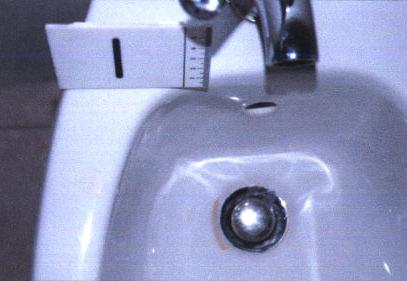
‘They’ve washed the knife. Amanda’s hurt from the fight. She’s bleeding too,’ Stefanoni replied. ‘The blob of her blood on the tap shows that she’s losing blood. It mixes with Meredith’s. She touches the cotton-bud box. Her blood is mixed with Meredith’s on her fingers. She switches off the light. At some point they try to clean up, get their feet dirty, leave marks.’
Someone played devil’s advocate: ‘Sorry, but surely the stuff in the plugholes could have come from either of them having their period?’
‘Not the same kind of blood,’ Stefanoni rebutted. ‘There’s a difference, I promise. Looks different, for a start.
"I promise." ??? I wonder how anybody would be able to tell the difference from the watered down traces in the washbasin and the bidet?
crime_scene_composite.jpg

...and then:
‘The most interesting thing isn’t the nice footprint in the corridor or on the bathmat, it’s that confused trace in Filomena’s room.’ The DNA specialist really came into her own now. ‘It’s mixed blood, Amanda and Meredith.’Mignini pressed on: ‘How do we know that it’s blood from both and not blood and biological material of another source?’
Stefanoni: ‘The peaks in DNA are much higher when produced by blood. Both Amanda’s and Meredith’s peaks are high. Both blood, I can assure you.’
Isn't it interesting, that Dottoressa Stefanoni doesn't mention the negative TMB test here? Just like she did in the document submitted to the court? It almost looks like Dottoressa Stefanoni is misleading the prosecution here...
But since DD is a work of fiction we can't hold the things the authors made up, against Dottoressa Stefanoni, can we?
 
I see. It's OK to mock Christians, but not atheists or other religions, some of which deliberately set out to destroy and maim innocent civilians. I have met several fans of Christopher Hitchens, yet when I read his book, all I saw was sad cynicism. Anyone can take the piss out of the Bible and Moses wandering around the desert for 40 years, not to mention all the blood-thirsty slayings and incest. Yet once the joke is over, what is left? Nothing.

As an example, one can jest that coffee is just a brown liquid, which is to fail to enjoy its inherent qualities of taste, natural uplift and health benefits. This is why Hitchins, Dawkins and jeering atheists are sad in general. When I was a youth, I mocked and jeered everything, but then I grew up.

Here endeth today's lesson.

Thank god for that (whoever he may or may not be).

...but seriously. It's ok to laugh at atheists...we don't mind.
 
The very foundations of philosophy are based on man pontificating about concepts of truth, beauty and the virtues (for example, Plato; St Augustine). How does one define such abstract ideas? Yet almost all rational persons accept there is such a thing as "good" and "bad". Whence do they arise?

OK so I come from a family where babies are routinely baptised, and yeah, I was given a cross to wear. I come from an old family with a pious background and quite austerely protestant. I was educated as Church of England where we were 'inculcated'every morning with prayers and hymns. In fact, many local councils still commence their meetings with a prayer. You could say that this was all, effectively, 'bullying'. However, I can honestly say that coming across john Bunyan's Pilgrim's Progress in English literature, age 11-12, I was completely blown away. Looking at it now, I cannot see why, but I guess it is as Calvin says, predestination: some hear the calling, others do not.

<shrug>

Given some of the world's greatest philosophers have been believers in a higher power, it is not reasonable for you to condemn all Christians as 'irrational' and by extension, 'all heathens are right'.

In relation to this current debate, you cannot claim to be superior in your views of guilt or innocence just because you are an atheist, which in itself is a belief. IMV politics, religion, and social attitudes are all interelated.

Once again you have missed the point....entirely.
 
Van der Leek's books are some of the best on the market. His perspicacity, analytical skills and insight are refreshing and bang on target.
Really?
To me it looks like he's just c/ping from TJMK and PMF and when he's trying to analyse things on his own, he's dead wrong.
But it looks like he has found another case to milk and jumped onto the "Making of a Murderer" hype...
 
Van der Leek's books are some of the best on the market. His perspicacity, analytical skills and insight are refreshing and bang on target.

VDL is a charlatan. A peddler of simplified claptrap and an unknown entity in his own country, South Africa.
 
Last edited:
The very foundations of philosophy are based on man pontificating about concepts of truth, beauty and the virtues (for example, Plato; St Augustine). How does one define such abstract ideas? Yet almost all rational persons accept there is such a thing as "good" and "bad". Whence do they arise?

OK so I come from a family where babies are routinely baptised, and yeah, I was given a cross to wear. I come from an old family with a pious background and quite austerely protestant. I was educated as Church of England where we were 'inculcated'every morning with prayers and hymns. In fact, many local councils still commence their meetings with a prayer. You could say that this was all, effectively, 'bullying'. However, I can honestly say that coming across john Bunyan's Pilgrim's Progress in English literature, age 11-12, I was completely blown away. Looking at it now, I cannot see why, but I guess it is as Calvin says, predestination: some hear the calling, others do not.

<shrug>

Given some of the world's greatest philosophers have been believers in a higher power, it is not reasonable for you to condemn all Christians as 'irrational' and by extension, 'all heathens are right'.

In relation to this current debate, you cannot claim to be superior in your views of guilt or innocence just because you are an atheist, which in itself is a belief. IMV politics, religion, and social attitudes are all interelated.

No, atheism is not a belief. It is a disbelief. If anyone can show me with empirical evidence that Jesus was in fact the son of the creator of the Universe, I will change my mind. Christians may be great and rational thinkers in many ways. I know many of them. However, the religious belief itself is in fact not based on rational thought or reasoning but It is based on "faith" which by its very definition is not based on proof. Every single time I debate with Christians, I face a morass of circular reasoning, appeals to authority and very often outright dishonesty.

This is also emblematic in discussions with you about this case. You elevate Stefanoni, the police and Mignini to ultimate authorities and dismiss the weakness of the case itself. Instead of discussing the actual evidence presented in the court case you present tabloid articles and crime novels. I long for an actual debate of the facts with the PGP, but I never see that. Just presuppositions and obfuscation.
 
Last edited:
Why did Amanda and Raff refuse to take the witness box over what they did the night of the murder?
I have only about a million references to the testimony of Amanda Knox at their trials?
Why would you lie about her not testifying when absolutely everyone in the world knows that she spent a great deal of time in the witness box: She even supplied spontaneous statements???????????
 
No, atheism is not a belief. It is a disbelief. If anyone can show me with empirical evidence that Jesus was in fact the son of the creator of the Universe, I will change my mind. Christians may be great and rational thinkers in many ways. I know many of them. However, the religious belief itself is in fact not based on rational thought or reasoning but It is based on "faith" which by its very definition is not based on proof. Every single time I debate with Christians, I face a morass of circular reasoning, appeals to authority and very often outright dishonesty.

This is also emblematic in discussions with you about this case. You elevate Stefanoni, the police and Mignini to ultimate authorities and dismiss the weakness of the case itself. Instead of discussing the actual evidence presented in the court case you present tabloid articles and crime novels. I long for an actual debate of the facts with the PGP, but I never see that. Just presuppositions and obfuscation.


Yes - a refusal to accept a belief is not the same as a belief system in and of itself (other than being a belief in the primacy of evidence-based proof).

And as you say, this has significant repercussions in any analysis of the Knox/Sollecito trials. I think that most commentators who harbour pro-guilt sentiments are doing so at least in part on a faith-based "reasoning": "I just think/know Knox and/or Sollecito is guilty" And then everything gets viewed through that distorted lens. And this IMO is also exactly what drove the thinking behind the PM/police investigations and the Massei court.

And in the case of any analysis of the Knox/Sollecito case, any judicial analysis (and, for that matter, any ethical analysis) must go far further than (for example) any analysis of a religious faith. In the case of faith, one must start as a true agnostic and be guided by the evidence (and lack of evidence). When looking at the Knox/Sollecito case, however, one must (for very sound reasons which have been expanded upon several times before in these threads) start with a presumption of innocence, and the sum of the evidence (and lack of evidence) must be tested against the innocence scenario - if it's compatible with an innocence scenario then this MUST be the conclusion.

When one sees a pro-guilt commentator write (just for example) that the refusal of Knox or Sollecito to subject themselves to cross-examination in court was necessarily indicative of guilt, one realises once again just how much poor thinking, faith-based "reasoning" and sheer ignorance of real life goes into their point of view (in this particular matter, almost any defendant - whether factually innocent or guilty - is almost always better off not being cross-examined by a prosecution lawyer in court, since a good prosecution lawyer can all too often get even a factually-innocent defendant to make statements that might be construed as indicative of guilt).

I am, and remain, extremely confident that I am correct in my current point of view on this case: that there is not one credible, reliable piece of evidence pointing unequivocally to the guilt of Knox and/or Sollecito, that the totality of the evidence (and lack of evidence) is wholly compatible with Guede acting alone (or, just possibly, with an unknown accomplice who left no evidence at the scene) and for Knox and Sollecito having nothing to do with the murder, that Knox and Sollecito should never have been found guilty in court for anything to do with the murder, and that it's a near certainty that Knox and Sollecito had nothing whatsoever factually to do with the murder. If other reliable, credible evidence comes alone which challenges my point of view, I will be readily prepared to modify it or even reverse it completely. I happen to think that no such evidence will ever materialise, but I'm open to at least the possibility.
 
Vixen said:
I have noticed the deliberate lies peddled by Amanda herself and the PR machine that she was tortured and interrogated for 53 hours, as well as starved and beaten by the police, who would not even let her go to the toilet.

Why the need for such lies, if innocent?

Why did Amanda and Raff refuse to take the witness box over what they did the night of the murder?

I have only about a million references to the testimony of Amanda Knox at their trials?
Why would you lie about her not testifying when absolutely everyone in the world knows that she spent a great deal of time in the witness box: She even supplied spontaneous statements???????????

How many times has a response to Vixen begun with, "It is the height of irony that........"?

But it is the height of irony that in a post where Vixen accuses Knox and this fictitious "PR machine" of lying, that Vixen herself lies through her teeth on something that can only be called a rookie-lie.... heck, even the charlatan Nick VDL knows that Amanda took the stand and was cross examined! How many posts has Vixen made that make a claim and the claim is virtually destroyed by applying the most elementary knowledge of this case? (Or does Vixen still claim there were no bars on the window below Filomena's?)

How many times does this have to happen before the mods here step in and protect their brand of skeptical, evidence based posting - the theoretical heart of this board? Why will the mods here not address this and discipline Vixen for repeated posts like the one above?
 
Last edited:
The presumption of innocence has been misunderstood here by many. The presumption only has to do with and during a trial. Before the charges are filed there is no presumption and after the verdict, if not guilty, there is no presumption of guilt, only that the prosecution could make a case for guilt beyond a reasonable doubt. A person found not guilty of a crime may be found guilty in a civil case over the exact same act.

In many nations, presumption of innocence is a legal right of the accused in a criminal trial, and it is also regarded as an international human right under the UN's Universal Declaration of Human Rights, article 11. The burden of proof is thus on the prosecution, which has to collect and present enough compelling evidence to convince the trier of fact, who is restrained and ordered by law to consider only actual evidence and testimony that is legally admissible, and in most cases lawfully obtained, that the accused is guilty beyond reasonable doubt. If reasonable doubt remains, the accused is to be acquitted.​

There is no scenario of innocence. The presumption is merely a mechanism to make clear the case must be beyond a reasonable doubt and that the defendant need not prove anything except defense offerings such as an alibi. Even the alibi need not be proven if there isn't a BARD case.

The system does not say the defendant is innocent but only presumed for the purpose of the trial.

A finding of not guilty is not a finding of innocent. Italy sort of has a way to declare a person innocent but as we have found many believe it shouldn't be used.

The presumption of innocence, sometimes referred to by the Latin expression Ei incumbit probatio qui dicit, non qui negat - the burden of proof is on the one who declares, not on one who denies​
 
No, atheism is not a belief. It is a disbelief. If anyone can show me with empirical evidence that Jesus was in fact the son of the creator of the Universe, I will change my mind. Christians may be great and rational thinkers in many ways. I know many of them. However, the religious belief itself is in fact not based on rational thought or reasoning but It is based on "faith" which by its very definition is not based on proof. Every single time I debate with Christians, I face a morass of circular reasoning, appeals to authority and very often outright dishonesty.

This is also emblematic in discussions with you about this case. You elevate Stefanoni, the police and Mignini to ultimate authorities and dismiss the weakness of the case itself. Instead of discussing the actual evidence presented in the court case you present tabloid articles and crime novels. I long for an actual debate of the facts with the PGP, but I never see that. Just presuppositions and obfuscation.


Really? I long for you to once, just once, make a sincere and honest argument for the kids' innocence. Instead we get bland platitudes about how Seattle loves 'em and how proud you are of Raff, now he is a crime commentator.


It has been shown that religious insight comes from the higher neo-cortex. IOW it is a recent evolution of the human brain and thus only advanced species have it. Superstition and base 'instinct' (which atheists believe explains the world) is governed by the most ancient part of the brain, near the back of the head.

It is atheists who adopt circular reasoning, which goes something like this; "It's my opinion...therefore it is so!"

ETA My acquaintance with Milgram and the works of Ayn Rand (Objectivism) made me conscious one should always question authority and consider, "Is this right for me? Is it ethical?"

Once or twice I have been unsure of directions in a strange location and so literally followed after others, only to discover they were not going the same way as me at all.

Lesson: you have to make the effort to find out things for yourself.
 
Last edited:
I have only about a million references to the testimony of Amanda Knox at their trials?
Why would you lie about her not testifying when absolutely everyone in the world knows that she spent a great deal of time in the witness box: She even supplied spontaneous statements???????????

Her testimony was strictly limited to specific issues only, such as the calunnia.
 
The presumption of innocence has been misunderstood here by many. The presumption only has to do with and during a trial. Before the charges are filed there is no presumption and after the verdict, if not guilty, there is no presumption of guilt, only that the prosecution could make a case for guilt beyond a reasonable doubt. A person found not guilty of a crime may be found guilty in a civil case over the exact same act.

In many nations, presumption of innocence is a legal right of the accused in a criminal trial, and it is also regarded as an international human right under the UN's Universal Declaration of Human Rights, article 11. The burden of proof is thus on the prosecution, which has to collect and present enough compelling evidence to convince the trier of fact, who is restrained and ordered by law to consider only actual evidence and testimony that is legally admissible, and in most cases lawfully obtained, that the accused is guilty beyond reasonable doubt. If reasonable doubt remains, the accused is to be acquitted.​

There is no scenario of innocence. The presumption is merely a mechanism to make clear the case must be beyond a reasonable doubt and that the defendant need not prove anything except defense offerings such as an alibi. Even the alibi need not be proven if there isn't a BARD case.

The system does not say the defendant is innocent but only presumed for the purpose of the trial.

A finding of not guilty is not a finding of innocent. Italy sort of has a way to declare a person innocent but as we have found many believe it shouldn't be used.

The presumption of innocence, sometimes referred to by the Latin expression Ei incumbit probatio qui dicit, non qui negat - the burden of proof is on the one who declares, not on one who denies​


No, this is fundamentally incorrect.

In fact, every person must be presumed innocent at every single stage - from the police investigation, through charges being brought, throughout a court trial, and beyond any trial process into perpetuity, until and unless the person is convicted by a legitimate trial process.

Perhaps you fail to see the importance of the words "presumption" and "presumed". At no point does the presumption of innocence make any active declaration of the person's innocence - it merely states that the person must be presumed innocent, in the absence of sufficient proof (BARD) of guilt. So even someone under police investigation, well before charges are brought, must be presumed innocent, and likewise a person acquitted in a fair trial process must be presumed innocent. And the presumption of innocence obviously applies only in a criminal-law context, where the burden of proof is necessarily and correctly extremely high. It's perfectly possible for someone to be acquitted in a criminal trial - thereby retaining the presumption of innocence - but to be found culpable on a balance-of-probabilities basis in a civil action over the same act.

Here's a link to a good academic paper that discusses the presumption of innocence, what it means, and how it is applied (and mis-applied and abused). Note how the paper specifically points to police errors in failing to follow the presumption of innocence doctrine during their investigations into a crime, and how the presumption of innocence is often (very often, in fact) overlooked - even by the criminal justice system itself, as well as by the media and public - when someone's criminal conviction is quashed at appeal:

http://www.innocencenetwork.org.uk/wp-content/uploads/2011/11/Vol-21-Naughton.pdf

You should find another source. The paper by an Innocence Project advocate actually complains that the status you claim exists, doesn't.

The presumption only exists during the trial for the express purpose of emphasizing the need of the state to prove BARD.

As it currently works in practise the presumption does not protect against wrongful
convictions as is widely supposed. In fact, it can actually facilitate them. Alternatively,
reflecting on the investigative approach of the University of Bristol Innocence Project, it
is argued that the innocent will be better protected against wrongful conviction only
when all resources and efforts are orientated towards subjecting the evidence claimed to
indicate guilt to critical interrogation to see if it can be substantiated​
 
This is because the „presumption,‟ in
effect, renders suspects of crime passive, which simultaneously justifies minimal resources to
the defence, whilst the „burden‟ places pressure on, and directs the bulk of the resources to,
the police and prosecution to chip away at the presumed innocent status and construct cases
from only incriminating evidence that might obtain a conviction, rendering innocent
victims vulnerable to wrongful convictions. As a result, the defence side of the adversarial
equation, widely thought to be the key safeguard against wrongful convictions, is largely
ineffectual as it is resource poor and reliant on police and prosecution evidence that is not
suitable for defending against cases constructed from such evidence. Political discourses on
the need to be „tough on crime‟ assist further in overcoming the apparent resistance of the
P.o.I. by facilitating the creation of legislation that removes safeguards against wrongful
convictions so that criminal convictions are easier to obtain.


This paper seems clearly to be a plea for more money for defense.
 
Status
Not open for further replies.

ISF - Join now!

Every member here is approved by hand. No bots, no spam, just people who care about evidence and honest debate.

Membership is free!

Create your free account

Back
Top Bottom