• Security incident: ISF was recently accessed by intruders. Please change your password, and change it anywhere else you used it. Read more

Cont: Deeper than primes - Continuation 2

Status
Not open for further replies.
It follows because ZFC is an example of classical Cantorian set theory (see http://projecteuclid.org/download/pdf_1/euclid.rml/1204834739 page 322) where any axiomatic system with multisets is a non-classical set theory.

Do you mean the page where the author says:
Classical Cantorian set theory as developed over the last one hundred years, and as formalized in its most popular form in Zermelo-Fraenkel set theory, is still our best candidate for a secure foundataion for mathematics.​
That page?
 
It is the set of all proper infinite subsets of N, and the diagonal set is actually a multiset, where each proper infinite subset of N is not a mutiset, so a theory that deals with both sets and mutisets has to be developed in order to solve this problem.

I see your argument continues to be fluid. So, it is a multiset now. If and when you can agree with yourself what you'd like to present, let me know. With things changing as frequently as they have, I will await you settling on something that can stay fixed for a while.
 
Do you mean the page where the author says:
Classical Cantorian set theory as developed over the last one hundred years, and as formalized in its most popular form in Zermelo-Fraenkel set theory, is still our best candidate for a secure foundataion for mathematics.​
That page?
That page talks also about pre-set theory, which you prefer to ignore.
 
I see your argument continues to be fluid. So, it is a multiset now.
No, the diagonalization across the members of the set of all proper infinite subsets of set N is a multiset, and therefore classical Cantorian set theory like ZFC can't deal with the considered subject.

You actually have missed the following part:
doronshadmi said:
So the diagonal set is at least of the form {1,1,1,...,2,2,2,...,3,3,3,...},
in http://www.internationalskeptics.com/forums/showpost.php?p=10996807&postcount=935.

Generally you ignore what is actually written in http://www.internationalskeptics.com/forums/showpost.php?p=10999158&postcount=940 and reply by using partial selected view of yours (as clearly seen in http://www.internationalskeptics.com/forums/showpost.php?p=10999186&postcount=941 and http://www.internationalskeptics.com/forums/showpost.php?p=10999191&postcount=942) about its actual content.

As long as your reasoning is only about "I've always favored ZFC (although the C part does cause me some discomfort)" and all you care is ZFC, there is no real discussion between us on the considered subject.
 
Last edited:
I see your argument continues to be fluid. So, it is a multiset now.
No, the diagonalization across the members of the set of all proper infinite subsets of set N is a multiset

As I said before, your argument is fluid. In the past year, the word multiset has appeared in this thread in exactly three posts. Scroll up a few posts from this to see them all.

You keep changing your argument. You changed it just today with your sudden leap to multisets. Let me know when you settle on something fixed.

...and therefore classical Cantorian set theory like ZFC can't deal with the considered subject.

Sure it can.

Be that as it may, it is obvious where your latest inspiration has come from. Google is your preferred method for grasping at straws. You googled "multiset ZFC" in the hopes of finding something to refute my observation ZFC doesn't distinguish {1,1} from {1}. Bingo! Up pops a PDF on multisets for you to misunderstand.

Well done!
 
Last edited:
It cannot be proven under ZFC, but not for the reason you give.

Sure it can.
What about consistency, jsfisher?

Be that as it may, it is obvious where your latest inspiration has come from. Google is your preferred method for grasping at straws. You googled "multiset ZFC" in the hopes of finding something to refute my observation ZFC doesn't distinguish {1,1} from {1}. Bingo! Up pops a PDF on multisets for you to misunderstand.

Well done!
Please explain my misunderstanding about pre-set theory as a foundation for both classical and non-classical theories.
 
Last edited:
Meanwhile here is my preliminary notion about collection of objects that each one of them has classical property and non-classical property as seen in the following matrix:

Code:
<
 1|1 , 1|2 , 1|3, . . .

 2|1 , 2|2 , 2|3, . . .

 3|1 , 3|2 , 3|3, . . .
  .     .     . .
  .     .     .   .
  .     .     .     .
>

If you take this matrix as a collection of infinite columns, then each object in a given column has left classical part and right non-classical part.

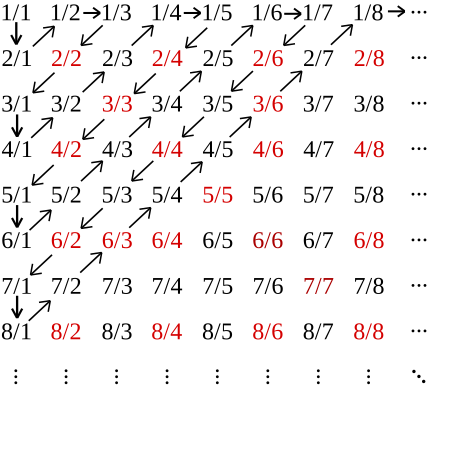
Make no mistake, this is not a matrix of all rational numbers yet the same zig-zag technique is determined along them as done in the following matrix

Diagonal_argument.svg

and we get the bijection

Code:
 1   2   3   4   5  ...

1|1 2|1 1|2 1|3 2|2 ...

So, the matrix has |N| objects and so is the case about the diagonal mutiset {1,1,1,...,2,2,2,...,3,3,3,...,...} that does not miss any member in the set of all proper infinite subsets of set N.
 
Let's refine the observation of http://www.internationalskeptics.com/forums/showpost.php?p=10999532&postcount=948 about collection of objects that each one of them has classical property and non-classical property as seen in the following matrix:

Code:
<
 1|1 , 1|2 , 1|3, . . .

 2|1 , 2|2 , 2|3, . . .

 3|1 , 3|2 , 3|3, . . .
  .     .     . .
  .     .     .   .
  .     .     .     .
>

If you take this matrix as a collection of infinite columns, then each object in a given column has left classical part and right non-classical part.

If you take this matrix as a collection of infinite rows, then each object in a given row has left non-classical part and right classical part.

Make no mistake, this is not a matrix of all rational numbers yet the same zig-zag technique is determined along them as done in the following matrix

Diagonal_argument.svg

and we get the bijection

Code:
 1   2   3   4   5  ...

1|1 2|1 1|2 1|3 2|2 ...

So, the matrix

Code:
<
 1|1 , 1|2 , 1|3, . . .

 2|1 , 2|2 , 2|3, . . .

 3|1 , 3|2 , 3|3, . . .
  .     .     . .
  .     .     .   .
  .     .     .     .
>

has |N| distinct objects, where  each distinct object is a ur-element that is constructed as a pair of classical and non-classical properties.

If ZFC  have ur-elements, it can deal with the following set of ur-elements or any conclusion that is based on ur-elements.
 
Last edited:
Let's be more careful about http://www.internationalskeptics.com/forums/showpost.php?p=11002986&postcount=951.

We have shown that the multiset {1,1,1,...,2,2,2,...,3,3,3,...,...} and the set {1,2,3,...} have the same cardinality, which is |N|.

In order to show it we have used a ZFU version (the U in the ZFU is for ur-elements) where some of the ur-elements in this ZFU version are constructed by classical and non-classical parts.

In any given matrix finite or infinite, the number of rows = the number of columns.

A given infinite set is not one of the members of the set of all of its proper infinite subsets, simply because a given infinite set is not its own proper subset.

In order to prove that a given infinite set is the one and only one member that is not a member of the set of all its proper infinite subsets, one has to prove that the cardinality the set of all proper infinite subsets of that given infinite set, has the same cardinality of that set, and only in this case the number of rows = the number of columns (which means that we are dealing with a matrix).
 
Last edited:
I'll make this quick:

Let's be more careful about http://www.internationalskeptics.com/forums/showpost.php?p=11002986&postcount=951.

We have shown that the multiset {1,1,1,...,2,2,2,...,3,3,3,...,...} and the set {1,2,3,...} have the same cardinality, which is |N|.

Who is "we"?

From my understanding, standard set theory does not allow a set that has the same element listed multiple times.

In order to show it we have used a ZFU version (the U in the ZFU is for ur-elements) where some of the ur-elements in this ZFU version are constructed by classical and non-classical parts.

Please list ALL axioms of ZFU since most people use ZF and/or ZFC. Do you even know what the C in ZFC is?

In any given matrix finite or infinite, the number of rows = the number of columns.

Row 1 of my matrix is whole numbers.
Row 2 of my matrix is all other numbers.
I have infinite columns but only two rows.

A given infinite set is not one of the members of the set of all of its proper infinite subsets, simply because a given infinite set is not its own proper subset.

In order to prove that a given infinite set is the one and only one member that is not a member of the set of all its proper infinite subsets, one has to prove that the cardinality the set of all proper infinite subsets of that given infinite set, has the same cardinality of that set, and only in this case the number of rows = the number of columns (which means that we are dealing with a matrix).

From what I remember, a set cannot be a subset of itself.
 
Who is "we"?
"We" is some agreed way to be focused on some subject instead of being focused on the particular person that expresses this subject.

From my understanding, standard set theory does not allow a set that has the same element listed multiple times.
But what is shown in http://www.internationalskeptics.com/forums/showpost.php?p=11002986&postcount=951 is not entirely based on standard set theory.

Please list ALL axioms of ZFU since most people use ZF and/or ZFC.
It is any ZF version that allows members that are not sets (known as ur-elements (https://en.wikipedia.org/wiki/Urelement)) and also multisets (https://en.wikipedia.org/wiki/Multiset), consistently.

Do you even know what the C in ZFC is?
The axiom of choice.

Row 1 of my matrix is whole numbers.
Row 2 of my matrix is all other numbers.
I have infinite columns but only two rows.
Thank you for this part.

I mean infinite square matrix so "(which means that we are dealing with a matrix)" has to be corrected in http://www.internationalskeptics.com/forums/showpost.php?p=11002986&postcount=951 to "(which means that we are dealing with a square matrix)".

From what I remember, a set cannot be a subset of itself.
A set can't be a proper subset of itself, and I use this fact in order to support my notions about the considered subject.
 
Last edited:
Last edited:
You are invited to show that ZF is inconsistent if ur-elements AND multisets are allowed.

If you are able to show it (maybe https://en.wikipedia.org/wiki/Axiom_of_extensionality and http://projecteuclid.org/download/pdfview_1/euclid.ndjfl/1143468313 can guide you), then ZF axioms explicitly do not allow ur-elements AND multisets and can't be considered as the foundation of mathematics.

You still didn't answer the question. I am more convinced that you cannot.
 
"We" is some agreed way to be focused on some subject instead of being focused on the particular person that expresses this subject.

"We" is not a way to do something. "We" is a pronoun. Let me give you some examples.

We know that doronshadmi can't leave messages alone; he keeps editing them, sometimes even after people have quoted them. Why do we keep expecting that doronshadmi can understand basic mathematical ideas? We need to stop thinking that doronshadmi will stop using standard mathematical terms and them redefine them for his own non-standard definitions.

But what is shown in http://www.internationalskeptics.com/forums/showpost.php?p=11002986&postcount=951 is not entirely based on standard set theory.
Yay! You got something right!!!

It is any ZF version that allows members that are not sets (known as ur-elements (https://en.wikipedia.org/wiki/Urelement)) and also multisets (https://en.wikipedia.org/wiki/Multiset), consistently.

Then you can post the axioms of "any ZF version that allows members that are not sets (known as ur-elements) and also multisets, consistently.

The axiom of choice.
Yay! Another one right!

Thank you for this part.

I mean infinite square matrix so "(which means that we are dealing with a matrix)" has to be corrected in http://www.internationalskeptics.com/forums/showpost.php?p=11002986&postcount=951 to "(which means that we are dealing with a square matrix)".
Ok. Then define classical and non-classical. All you have done is indexed items. No other work was done.

A set can't be a proper subset of itself, and I use this fact in order to support my notions about the considered subject.
That's wonderful, but it is NOT what I said. Also, re-examine the definition of subset. Very briefly, a subset is part of (or contained) within another set. Explain how a set can be a subset of itself.
 
You still didn't answer the question. I am more convinced that you cannot.
You and little 10 toas actually do not understand what is the meaning of "a ZF version", so let me help you.

"a ZF version" means that some axioms of ZF have to be modified in order to allow, for example, Ur-elements.

Such an example is given in https://en.wikipedia.org/wiki/Axiom_of_extensionality#In_set_theory_with_ur-elements and both of you simply ignore it:

"Given any set A and any set B, if A is a nonempty set (that is, if there exists a member X of A), then if A and B have precisely the same members, then they are equal".
 
Last edited:
Ok. Then define classical and non-classical. All you have done is indexed items. No other work was done.
Classical in this context means that repetition of elemens is not allowed.

Non-classical in this context means that repetition of elements is allowed.

What I did in http://www.internationalskeptics.com/forums/showpost.php?p=11002986&postcount=951 is to use an OR logical connective between classical \ non-classical collections, which enabled me to conclude that the mutiset {1,1,1,...,2,2,2,...,3,3,3,...,...} and the set {1,2,3,...} have the same cardinality, which is |N|, if the considered structure is an infinite square matrix.

That's wonderful, but it is NOT what I said.
What you say is irrelevant to proper infinite subsets.

Again, in order to prove that a given infinite set is the one and only one member that is not a member of the set of all its proper infinite subsets, one has to prove that the cardinality of the set of all proper infinite subsets of that given infinite set, has the same cardinality of that set, and only in this case the number of rows = the number of columns (which means that we are dealing with an infinite square matrix).

It is a simple fact that each proper infinite subset of set N has |N| members, and so is the case of any possible diagonal set across |N| proper infinite subsets of set N (which means that our measured structure is an an infinite |N|*|N| square matrix).

In order to conclude that set N is not the one and only one set that is not included in the infinite square matrix, one has to construct some proper infinite subset of set N, which is different than all of the proper infinite subsets of set N in the given infinite |N|*|N| square matrix.

 
Last edited:
Status
Not open for further replies.

ISF - Join now!

Every member here is approved by hand. No bots, no spam, just people who care about evidence and honest debate.

Membership is free!

Create your free account

Back
Top Bottom