There certainly is a difference between how failures occurring in brittle and ductile materials. Ductile materials do not instantaneously snap when overloaded and the process takes time. At least you admit that you aren't an expert on this because it is clear you aren't. You obviously don't have an answer for why the horizontal propagation across the entire North Tower's 98th floor occurred in less than a second. I am not the one handwaving here Dave.
Yes you are. Materials are not divided into two distinct classes; rather, they fail in different ways according to the way excessive force is applied. If steel is loaded quickly enough, it can snap rather than bending. You might also want to consider the behaviour at the various bolted and welded connections, which can also fail very quickly. And, finally, you're pulling a good old Unevaluated Inequality Fallacy; you say the propagation was too fast, but you're not giving numbers for how fast it should have been, or even how fast it was. In effect, you're claiming I should accept an argument you haven't even articulated.
They don't remove the columns in the Verinage technique until they drop the building. Your answer here is a poor attempt at handwaving too.
Look at some videos. The whole point of the technique is to remove any structures that prevent shear failure of a floor, then induce that shear failure with hydraulics. Large amounts of the structure are removed, so that an entire floor's worth of columns fail simultaneously, leading to a well-defined drop.
But actually, your whole argument here is quite hilarious. You say that an aspect of the WTC collapses doesn't resemble an aspect of a type of controlled demolition, therefore the WTC collapses must have been a controlled demolition. Let's look at the logic:
P1: If a subset of A, then B (Verinage, a form of CD, produces a deceleration).
P2: Not B (no deceleration was seen).
C: Therefore A (the collapse was a CD).
I don't think there's even a name for that fallacy. Congratulations, you've invented a new way of being wrong.
There is no legitimate deceleration in anybody's data for the measurement of the descent of the upper section of the North Tower (Chandler measured it also). Once the data I had was corrected for the smoothing it was even worse. This argument of yours reminds me of someone who disagrees emotionally with what a technical paper shows and when they find a typo want to use it to dismiss the paper's premise. You are being disingenuous here and you have to know it.
Tony, I can re-post
your data, and everyone can work out the deceleration for themselves. And once you corrected it for the smoothing - not, of course, a typo, this was a major error in interpretation - then as expected it gets less smooth, and the type of excursion you're looking for becomes visible.
What the hell, let's look at it. Here's your data, with accelerations calculated from it.

Here's a plot of the accelerations, not smoothed.
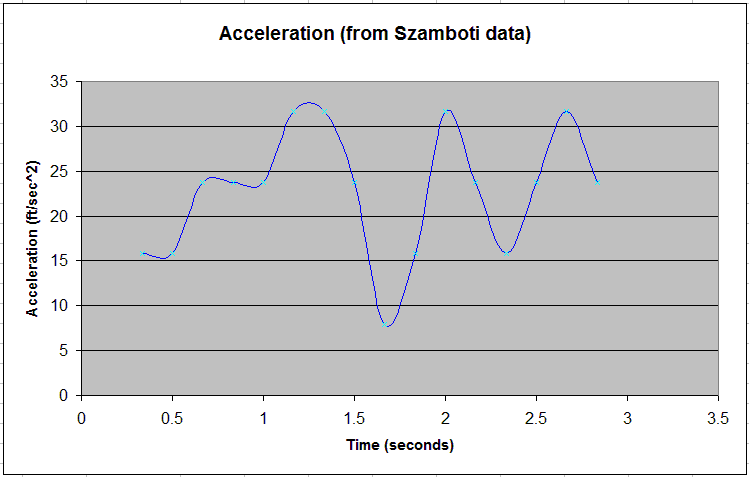
Look at all those jolts in your data. That's why you had to pretend that a 31G deceleration was expected, possibly the most bizarre suggestion you've ever made.
All these years. You learn nothing.
Dave



