Cont: Deeper than primes - Continuation 2

Status
Not open for further replies.
It is well known that mathematicians avoid diagrams as rigorous mathematical proofs because of optical illusions that may involved with them.

Nevertheless, proof without words is accepted if it
... can be demonstrated as self-evident by a diagram without any accompanying explanatory text.
(http://en.wikipedia.org/wiki/Proof_without_words)

I claim that there are also symbolic illusions that can be discovered if both visual AND symbolic methods are combined in some mathematical work, for example:

15173708254_b8dfa4cebf_z.jpg


In this diagram (where visual AND symbolic methods are involved) 0.111...2 = 1 if only |N| observation of the real-line is used.

By using the same diagram (where visual AND symbolic methods are involved) 0.111...2 < 1 if also |R| observation of the real-line is used.

In this case 0.111...2 < 1 by exactly 0.000...12, where the value 0.000...12 is rigorously analyzed as follows:

The value 0.000...12 acts differently than value 0, as follows:

The ".000..." is used as a |N| size place value keeper that is inaccessible to "...12" that is at |R| size.

----------------------
The following is an example of symbolic illusion (that is discovered by using also |R| observation of the real-line) simply because n = 0 to ∞ is a hands-waving that misses the fact that |N|<|R| (as rigorously given by the diagram above (where visual AND symbolic methods are involved)):
[qimg]http://i346.photobucket.com/albums/p412/julietrosenthal/9repeatingequal1proof_zps2404921b.png[/qimg]

As for n = 0 to ∞, 0.999...10 obviously does not involved with (9/10)*(1/10|N|) simply because |N| is not one of the values of any collection of |N| finite values (and this is exactly the case of the parallel-summation of finite |N| values 0.9+0.09+0.009+... that are based on the convergent sequence of <0.9,0.09,0.009,...> finite |N| values).
 
Last edited:
In this case 0.111...2 < 1 by exactly 0.000...12, where the value 0.000...12 is rigorously analyzed as follows:

The value 0.000...12 acts differently than value 0, as follows:

The ".000..." is used as a |N| size place value keeper that is inaccessible to "...12" that is at |R| size.
I have two functions, graphed for your convenience:

f(x) = 1 + 1/x
g(x) = 1 - 1/x​

Therefore:

f > 1 > g for all x in (0, ∞)​

In your notation, there must be a value L such that:

f - L = 1 = g + L as x -> ∞​

But notice that:

f = 1 + L as x -> ∞
f - 1 = L as x -> ∞

and

g = 1 - L as x -> ∞
g - 1 = L as as x -> ∞

Therefore

f - 1 = g - 1 as x -> ∞
f - g = 1 - 1 as x -> ∞
f - g = 0 as x -> ∞​

The difference separating between f and g is exactly 0 as x -> ∞. Therefore:

f = 1 = g as x -> ∞​

QED

---

Let's carry this a little further. Note that we can derive f' and g' in terms of f and g as follows:

f'(x) = f(x) - L = 1 + 1/x - L
g'(x) = g(x) + L = 1 - 1/x + L​

Observe that:

f'(1) > f'(2) > f'(3) > . . . > f'(x) > 1 for all x in (0, ∞)
and
f(x) > f'(x) for all x in (0, ∞)

Therefore f(x) > f'(x) > 1 for all x in (0, ∞)​

Likewise:

g'(1) < g'(2) < g'(3) < . . . < g'(x) < 1 for all x in (0, ∞)
and
g(x) < g'(x) for all x in (0, ∞)

Therefore g(x) < g'(x) < 1 for all x in (0, ∞)​

Because f' > 1 and 1 > g', the following inequality must hold:

f' > 1 > g' for all x in (0, ∞)​

In your notation, there must be a value M such that:

f' - M = 1 = g' + M as x -> ∞​

Everything looks good here ^_^ From this, we can infer:

f - L = f' - M
and
g + L = g' + M​

And with a little algebra, we can write:

f - f' = L + M
and
g - g' = M - L​

But remember, f' was defined as f - L, and g' was defined as g + L. Let's re-write the expressions above in terms of f and g:

f - (f - L) = L + M
and
g - (g + L) = M - L​

Simplifying:

f - (f - L) = L + M
f - f + L = L + M
0 + L = L + M
L = L + M
(L - L) = M
0 = M

and

g - (g + L) = M - L
g - g - L = M - L
0 - L = M - L
-L = M - L
(-L + L) + M
0 = M​

So, M = 0 and (L - L) = M implies L = 0. Because L = M = 0, then

f(x) = f'(x) and g(x) = g'(x) as x -> ∞
and
f - L = 1 = g + L as x -> ∞ implies that f - 0 = 1 = g + 0 as x -> ∞

Therefore f = 1 = g as x -> ∞​

QED.

--

You can generalize this further for f''(x) = f'(x) - M, f'''(x) = f''(x) - N, . . . , and so on to show that L = M = N = ... = 0.

We assume that 0.000...1 must be some C in an expression fa(x) = fa - 1(x) - C for any a > 1, so C = L = M = N = .... = 0.

Therefore, there exists is no C = 0.000...1 such that C > 0.

QED.
 
Last edited:
:duelAwesome!

Edit: Dessi, please be persistent... I am nowhere near as rapierlike in mathematical argumentation, I am just muleheaded persistent when it comes to Doronetics.

I am so going to enjoy this thread (together with people like jsfisher we are in this thread like over 7 or 8 years now...)

:popcorn2
 
Last edited:
Therefore f = 1 = g as x -> ∞
Dear Dessi,

All your poofs are based on x -> ∞.

We know that there are infinitely many levels of infinity, for example:

|N| < |P(N)| < |P(P(N))| < ... etc. ad infinitum.

So when you are using ∞, what level of infinity you are using?

Again, 0.999...10 = 1 if we observe the real-line from level |N|.

This is not the case if we observe the real-line from level |R|.

In this case 0.999...10 is the result of parallel-summation of countable |N| finite values, where this result is inaccessible to 1 exactly by the value 0.000...110, such that ".000..." is used as a countable |N| level place value keeper that is inaccessible to "...110" that is at uncountable |R| level.

As long as you are not rigorously define ∞, x -> ∞ has nothing to do with the fact that there are infinitely many levels of infinity, and my argument is based on this fact.

So if you really wish to write any meaningful reply about my argument, you have to do that by explicitly not ignore the fact that there are infinitely many levels of infinity.

Can you demonstrate how your proofs hold also if you do not ignore the fact that there are infinitely many levels of infinity?
 
Last edited:
As long as you are not rigorously define ∞, x -> ∞ has nothing to do with the fact that there are infinitely many levels of infinity, and my argument is based on this fact.

So if you really wish to write any meaningful reply about my argument, you have to do that by explicitly not ignore the fact that there are infinitely many levels of infinity.

Can you demonstrate how your proofs hold also if you do not ignore the fact that there are infinitely many levels of infinity?

Doron, when have you, in all these years, *ever* defined *anything* rigorously?

And stop playing 'reductio ad absurdum'.
 
In this case 0.999...10 is the result of parallel-summation of countable |N| finite values, where this result is inaccessible to 1 exactly by the value 0.000...110, such that ".000..." is used as a countable |N| level place value keeper that is inaccessible to "...110" that is at uncountable |R| level.
I promise you, I am far from a math noob, but I'm afraid the statement above is unreadable. I don't understand what you are describing.

Its not clear to me how the expression 0.000...1 > 0 can be constructed at all. Could you provide a function which computes C = 0.000...1, then a provide a proof that C > 0.

As long as you are not rigorously define ∞, x -> ∞
Let's go back to our equations:

f(x) = 1 + 1/x as x -> ∞
f(x) = 1 - 1/x as x -> ∞​

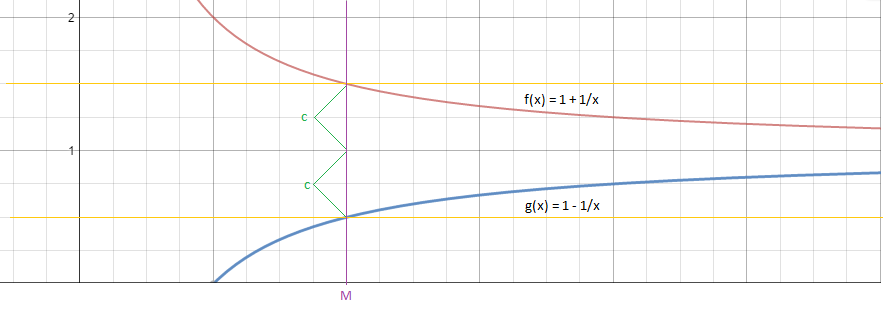
Let's annotate this graph a little:

limitexample_zps91c00637.png


Note that x -> ∞ is the same as saying c -> 0, so:

f(x) = 1 + 1/x as c -> 0 = g(x) 1 - 1/x as c -> 0​

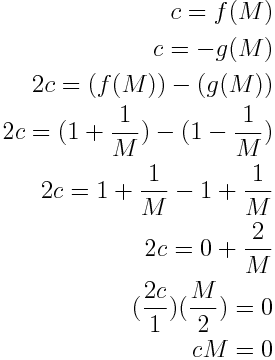
So, for every M > 0, there exists a number c such that 2c = f(M) - g(M). A c = 0 must exist because:

limitexample2_zps67fe9e7b.png


If M > 0, then c = 0. Therefore, existence of a limit L at c -> 0 implies the existence of L at x -> ∞. The rigorousness of f(x) as x -> ∞ is proven.

QED

Can you demonstrate how your proofs hold also if you do not ignore the fact that there are infinitely many levels of infinity?
Let R bet the set of real numbers
Let N be a superset of real numbers R
Let f be the injective function from R to N
Let P be a proof function on the set of real numbers R
Let P' be the proof P(f(R))
Therfore, for every P(R) there exists a P'(N)

Which is a very pretentious way of saying my proof in the set of real numbers implies existence of a proof in any superset of real numbers. In other words, the expression C = 0.000...1 where C > 0 cannot be constructed any superset of real numbers, for any |N| > |R|, where |s| refers to the cardinality of the set s.

QED.

Apologies if I've misunderstood what you are trying to communicate.
 
Last edited:
Show your proof.
Again, the following quote is true because |N|<|R| is true:
In this case 0.999...10 is the result of parallel-summation of countable |N| finite values, where this result is inaccessible to 1 exactly by the value 0.000...110, such that ".000..." is used as a countable |N| level place value keeper that is inaccessible to "...110" that is at uncountable |R| level.
As long as you are missing it, you actually missing my theorem.


In other words, the expression C = 0.000...1 where C > 0 cannot be constructed any superset of real numbers, for any |N| > |R|, where |s| refers to the cardinality of the set s.

Apologies if I've misunderstood what you are trying to communicate.
Dear Dessi,

For example:

C = 0.000...110 is constructable only if you observe the real-line from |R|uncountable level.

By doing this the place value example 0.999...10 (which is at most at |N| countable level of the real-line) is a value of its own along the real that is < 1 exactly by C.
 
Last edited:
C = 0.000...110 is constructable only if you observe the real-line from |R|uncountable level.

By doing this the place value example 0.999...10 (which is at most at |N| countable level of the real-line) is a value of its own along the real that is < 1 exactly by C.

Can you show a proof?

Could also clarify the expression "observe the real-line from |R|uncountable level"? I've never heard that expression before, I don't know what you are describing.
 
Last edited:
I promise you, I am far from a math noob, but I'm afraid the statement above is unreadable. I don't understand what you are describing.

Its not clear to me how the expression 0.000...1 > 0 can be constructed at all.
It is constructable only if you observe the real-line from |R| level, and as a result, for example, 0.999...10 (which is a value of its own at |N| level, if it is observed from |R| level) < value 1, exactly by 0.000...110

Please do not ignore anything of post http://www.internationalskeptics.com/forums/showpost.php?p=10326245&postcount=41 if you really wish to know my theorem.
 
Last edited:
Dessi said:
I promise you, I am far from a math noob, but I'm afraid the statement above is unreadable. I don't understand what you are describing.
It is constructable only if you observe the real-line from |R| level, and as a result, for example, 0.999...10 (which is a value of its own at |N| level, if it is observed from |R| level) < value 1, exactly by 0.000...110

The highlighted statement clarifies nothing. I have no idea what you are saying. You are obviously talking about some mathematical abstraction, but I'm afraid I can't guess that abstraction is or how its derived.

Could you tell me what you think the real line is, what |R| means, what the expression "observe the real line from |R| level" refers to? After that, can you show how these things allow you to write a function which computes 0.000...1 > 0?
 
Last edited:
Can you show a proof?

Could also clarify the expression "observe the real-line from |R|uncountable level"? I've never heard that expression before, I don't know what you are describing.
You never heard of that expression before because it is (probably) novel thing about the real-line, that was not used (yet) by traditional mathematicians, even if |N|<|R| is an established mathematical fact.

Did you read all of http://www.internationalskeptics.com/forums/showpost.php?p=10326137&postcount=40 before you replied?
 
Last edited:
Could you tell me what you think the real line is, what |R| means,
The real line is the set of real numbers where |R| is the cardinality of that set.

So, as you see, I use well-defined mathematical knowledge.
 
The real line is the set of real numbers where |R| is the cardinality of that set.

So, as you see, I use well-defined mathematical knowledge.

Me: Could you tell me what you think the real line is
You: The real line is the set of real numbers
Me: I understand this. :)

Me: what does |R| mean?
You: |R| is the cardinality of that set of real numbers
Me: I understand this. :)

Me: what does the expression "observe the real line from |R| level" refer to?
You: :confused:
Me: :confused:

Me: how does one construct the expression 0.000...1 > 0 at all?
You: It is constructable only if you observe the real-line from |R| level
Me: :(

Whatever manner one "observes the real line from |R| level" is most certainly not well-defined mathematical knowledge.
 
Last edited:
Can you show a proof?

Ooh, ooh, I know, I know. No, Doron cannot.

Could also clarify the expression "observe the real-line from |R|uncountable level"? I've never heard that expression before, I don't know what you are describing.

Ooh, ooh, I know, I know. No, Doron cannot.


Curiously enough, Doron also rejects Cantor's Theorem, yet he relies on its results. Limits are an issue for him, too, but you probably noticed that by now.
 
Me: how does one construct the expression 0.000...1 > 0 at all?
Dear Dessi,


There are two levels of infinity in |N|<|R|.

There are |N| place value keepers in ".000...", which are symbols at |N| level that are inaccessible to "...1", because it is a symbol at |R| level.
 
Status
Not open for further replies.

Back
Top Bottom