So can you come up with anything else? What's your best argument in defense of materialism?
Not sure what "materialism" means, but I think "made of atoms" is a pretty good starting point. Apologies if I've misunderstand your definition of the word.
If atoms didn't exist, we'd have a pretty hard time explaining electronic microscopy:
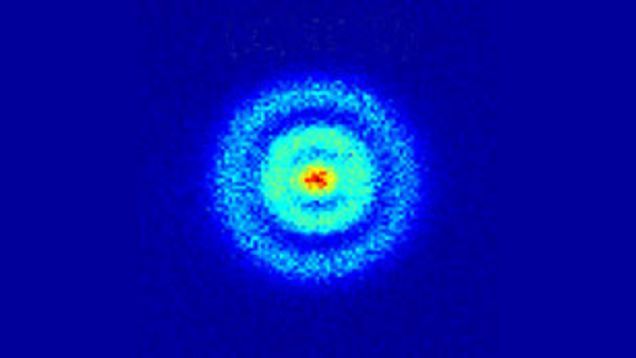
If atoms didn't exist, we'd also have a hard time accounting for photoionization microcopy which captures their
orbital structure:
The predictive nature and success of chemistry, particle physics, quantum mechanics, optics, electromagnetism, superconductivity, relativity, crystallography, nuclear engineering -- essentially
the entirety of the natural sciences -- provides persuasive evidence of atoms. It's not clear how these sciences would hold together if they weren't unified by a solid theory of atoms.
Identifying, categorizing, and classifying each into discrete elements; then identifying the isotopes of these elements; then identifying their sub-atomic parts; then identifying the orbital shells of electrons; then identifying even smaller more elementary particles; etc seems to provide persuasive evidence that atoms exist.
Mendeleev classifying elements, and making accurate predictions about the properties of undiscovered elements, provides evidence that atoms exist, have tangible properties, and can be known.
Predictions of the existence of sub-atomic particles and their properties, such as the Higg's boson in 2013 (theorized in 1964) and the recently discovered
Majorana fermion (theorized in 1937) provides evidence that atoms and more elementary particles exist, and more importantly that we can determine their properties before we ever detect them directly.
The existence of machines which we can use to
literally take pictures of atoms, fission reactors which split heavy isotopes, super conducting super colliders crashing particles together and bursting them into more elementary particles, cannot and does not make sense without the existence of atoms.
Projects like
folding@home construct models of proteins and simulate their behavior atom-by-atom, and are able to make useful prediction. Discovery of the helical nature of DNA only makes sense if the helical structure refers to a specific arrangement of atoms. I can go on if you like. The point is that atoms aren't some kind of weird, conceptual, convenient fiction; they exist concretely.
The best argument for a material universe is that it looks, acts, and behaves like a material universe.
The best argument against a material universe is that it looks and acts nothing like material universe.
This ring of atoms produces a
quantum mirage, in that there appears to be an atom in the center of the ring when here is not,
a result of the wave-like nature of atoms. Even
large molecules behave like waves,
similar to this animation. And for some reason, at very small levels, waves don't even behave like infinitely smooth curves, but more like discrete,
fundamentally digital states, like a
universe-sized cellular automata. What the hell, physics?
What's your best argument against monistic idealism?
It neither adds nor subtracts from any information or facts in the universe. It communicates precisely nothing which one could use to derive new or novel information.
I'm at a loss here trying to understand how your ontology is useful, and in what way. In what sense does your ontology add to the understand of anything, when it apparently does not add to anyone's understand of anything?
For what its worth, you make an interesting comment in your OP: "
I subscribe to the much more parsimonious and skeptical notion that reality is in a trans-personal form of consciousness, of which we are localizations -- like whirlpools in a stream."
I think your position is skeptical in the same way that "my mind and mine alone exists" is skeptical; skeptical, sure, but not at all a good explanation of anything. That aside, I rather like your 'whirlpools of consciousness' imagery. You might be interested to see what the whirlpools actually look like (or at least a good simulation ^_^). You will need a browser which supports HTML5+OpenGL, such as Chrome or an up-to-date version of IE to see this 3-dimensional model of a biological neural net:
http://nxxcxx.github.io/Neural-Network/
The algorithm behind this simulation is extremely simples. Each neuron has a weighted-random chance of activating its neighbors, which in turn randomly activate their neighbors, and so on in a cascade activity. This neural net does not appear to have dynamically weighted edges, so it cannot be trained, but it serves the purpose of being pretty very well.
In our lifetimes, we can expect to see more sophisticated simulations,
similar to this:
A team of Japanese and German researchers have carried out the largest-ever simulation of neural activity in the human brain, and the numbers are both amazing and humbling.
The hardware necessary to simulate the activity of 1.73 billion nerve cells connected by 10.4 trillion synapses (just 1 percent of a brain’s total neural network) for 1 biological second: 82,944 processors on the K supercomputer and 1 petabyte of memory (24 bytes per synapse). That 1 second of biological time took 40 minutes, on one of the world’s most-powerful systems, to compute.
Compare to the human brain, which appears easily capable of operating 100 billion neurons in real time, using around 20 watts of energy. Obviously our computer simulations have a long way to go, but this is an emerging and exciting area of research for computer scientists. I predict seeing more and more simulations of this nature, modeling
more neurons in
shorter intervals of time, for the next few decades.
Perhaps I'm biased, being computer science geek, but the brain is very sophisticated, physical implementation of a neural network. There's no clear reason why the neural net implementation is limited to a medium of physical brains and neurons. A computer simulation of brain activity should behave as if it actually has physical brain activity, analogous to its
meatspace counterparts. I don't believe it's even necessary to simulate a brain atom-by-atom, which would be overkill in the extreme. As a programmer, I would be more interested in an artificial neural net with the statistical properties, clusters of specialized computation, and dynamically weighted edges similar to a biological neural net.
In my lifetime, I believe there is a high likelihood that neurologists will discover the minimum set of neurological structure which correlates with consciousness. And almost immediately, computer scientists will set out to model the structure, 3D printing consciousness into a computer chip.
I believe this would sufficiently falsify the view that conscious experience uniquely escapes description in a material universe.





 ?
?


