• Quick note - the problem with Youtube videos not embedding on the forum appears to have been fixed, thanks to ZiprHead. If you do still see problems let me know.

Total Building Collapse from a Single Column Failure

I do not talk for AE911, but the call here is for NIST to correct their analysis.


Not the case - bare assertion.


I would envisage such an analysis being done commercially by an established firm in that area of expertise, not by AE911. Even in links provided by your good friends on this thread about FEA it is stated that omissions should be noted and quantified. NIST did no such thing with their analysis. They need to revisit this.

Since their conclusions won't change one bit, they don't need to do anything. Get over yourself.
 
Since their conclusions won't change one bit, they don't need to do anything. Get over yourself.
You need to start getting real with yourself. NIST made a total mess of their analysis, and all you can do is predict what an analysis with the correct elements accounted for would produce. You have nothing to justify your assertion.
 
Are you removing the artificial stiffening that NIST included in the seat itself?

Just asking...

It has already been shown that expansion of one beam a couple of inches would be enough to move the girder off its seat (with the other end being fixed) Troofers hand wave that FACT away in order to keep their religion alive.....not to mention the column being pushed eastward that they also handwaved away.

Simple fact is that no one outside of the troofer bubble has claimed that the web stiffeners would be a significant change. (I have a hunch that the total movement projected by the simulations is more than enough for the girder to fail)
 
Last edited:
You need to start getting real with yourself. NIST made a total mess of their analysis, and all you can do is predict what an analysis with the correct elements accounted for would produce. You have nothing to justify your assertion.

I knew what took down WTCs 1,2 AND 7 before they even hit the ground, junior.


And guess what? It's working on 13 years later and I've yet to be proven wrong.

Your problem lies in your hilariously failed assumption that the world needs the NIST report to know what happened. That is simply not the case.
 
Last edited:
You need to start getting real with yourself. NIST made a total mess of their analysis, and all you can do is predict what an analysis with the correct elements accounted for would produce. You have nothing to justify your assertion.

Troofer projection at its finest. :rolleyes:
 
Well, have you asked them?

NIST need to re-evaluate their analysis because that analysis is erroneous. Their motivation should be accuracy and truth surely, not mainstream media pressure. They have already admitted the omission of these plates and their analysis does not account for them. Earlier in the thread, someone said that a full analysis would be required to justify the relevance of the plates. I agree with that, and it is incumbent upon NIST to perform such an analysis.

How erroneous is their analysis? A little? A lot?

They were trying to find a likely reason the building collapsed. They ruled out CD, so the simulation HAS to have the building collapse due to fire. Would they have found some other column? Some other girder? How much of a difference to the safety of large structures would it mean? These are the questions you need to establish an answer to in order to say how wrong they are.

Remember, the simulation CANNOT show the building DID NOT collapse, because it did.
 
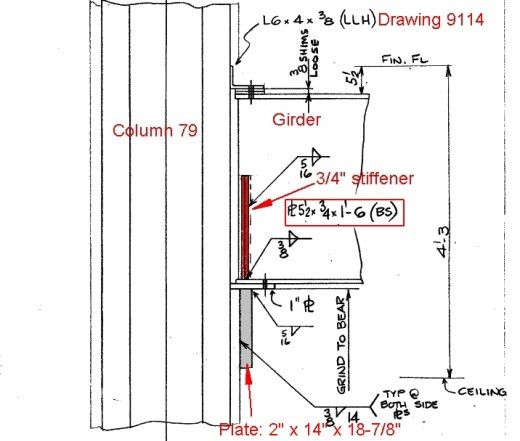
Are you talking about the plates that were included BELOW the girder here?

the NIST report ststes that the FEA included a girder seat that was essentially infinitely stiff. I forget the exact wording, its been discussed in this and the other thread before.

NIST need to re-evaluate their analysis because that analysis is erroneous. Their motivation should be accuracy and truth surely, not mainstream media pressure. They have already admitted the omission of these plates and their analysis does not account for them. Earlier in the thread, someone said that a full analysis would be required to justify the relevance of the plates. I agree with that, and it is incumbent upon NIST to perform such an analysis.

As I said above, none of the well established authoritative engineering groups has cast such doubt on the report or the FEA itself and none have called for a re-investigation. AE911T is alone in that stance and is an organization with a single purpose and open to anyone rather than one dedicated to professional construction engineering.
So, no, there is no case making it incumbent upon them to redo the FEA.

AE911T has a beef with it, AE911T is quite welcome to commssion a new analysis.
 
the NIST report ststes that the FEA included a girder seat that was essentially infinitely stiff. I forget the exact wording, its been discussed in this and the other thread before.
The stiffener plates are above the bottom flange of the girder. You are not even talking about the correct element.


As I said above, none of the well established authoritative engineering groups has cast such doubt on the report or the FEA itself and none have called for a re-investigation. AE911T is alone in that stance and is an organization with a single purpose and open to anyone rather than one dedicated to professional construction engineering.
So, no, there is no case making it incumbent upon them to redo the FEA.

AE911T has a beef with it, AE911T is quite welcome to commssion a new analysis.
The CTBUH asked the question re the plates while the report was out for public comment and well before the structural drawings were made public. So you are totally wrong.
 
What are stiffener plates made out of? What material?
Seriously?
bmie-520w_zpsd1fc4473.jpg
 
Seriously?
[qimg]http://i1237.photobucket.com/albums/ff475/TwitchingLima/bmie-520w_zpsd1fc4473.jpg[/qimg]

Can you tell me the creep you need to account for when using 20 sigs of 100# Dull CT with a 80# Coated Cover when saddle stitching? No?

Then I suggest you change your tone, and accept the fact that you do not need to be an engineer, architect, fire expert or construction guru to know 9/11 conspiracy theories are full of :rule10:


Oh, and if the answer is steel, which is clearly missing from your flippant answer, then why in the world would it not suffer the same consequenses as the girder it's trying to protect?
 
Last edited:
Can you tell me the creep you need to account for when using 20 sigs of 100# Dull CT with a 80# Coated Cover when saddle stitching? No?

Then I suggest you change your tone, and accept the fact that you do not need to be an engineer, architect, fire expert or construction guru to know 9/11 conspiracy theories are full of :rule10:


Oh, and if the answer is steel, which is clearly missing from your flippant answer, then why in the world would it not suffer the same consequenses as the girder it's trying to protect?
Hypothetically - what if the same program were used to produce an FEA using NISTs own variables, and the girder didn't fail?
 

Attachments

  • nearly9.jpg
    nearly9.jpg
    40.8 KB · Views: 10
Oh, and if the answer is steel, which is clearly missing from your flippant answer, then why in the world would it not suffer the same consequenses as the girder it's trying to protect?
I agree that the girder and the plates would both be subjected to heat. That does your argument more harm than good. Wouldn't the girder be hard up against the column face at 500C, and be on the inside of the side plates?
Clearly it would, and you need to account for that in your argument.
 
You're welcome. It's good that you can see the absurdity of the position you are taking. Good for you, for admitting this.

Uh huh.

So how's the arson argument coming along? You and Tony figure out if it was started before or after the Twin Towers collapsing yet?

I look at that image, and see that if NIST did in fact include the stiffeners, zero conclusions change. I can say this with 100% certainty as that's exactly what happened. You guys need a new hobby.
 
I love this idea that thousands of pounds of both dead and live loads can hang off of an 0.75" steel flange if it's properly stiffened. Why don't we build all our buildings like that? Surely it'd save millions of dollars in steel costs not to use 11" wide load-bearing seats and full I-beams, right? When a web and flange with stiffener is even safer than the traditional construction, who wouldn't want to use it?
 
I love this idea that thousands of pounds of both dead and live loads can hang off of an 0.75" steel flange if it's properly stiffened.
So do I. Great isn't it.
Why don't we build all our buildings like that?
We do. That's why the CTBUH asked about the inclusion of these elements without having seen the drawings.
Surely it'd save millions of dollars in steel costs not to use 11" wide load-bearing seats and full I-beams, right? When a web and flange with stiffener is even safer than the traditional construction, who wouldn't want to use it?
Nobody used an 11" seat anywhere in this connection. Have you actually looked into this issue at all?
 

Back
Top Bottom