• Quick note - the problem with Youtube videos not embedding on the forum appears to have been fixed, thanks to ZiprHead. If you do still see problems let me know.

Air show crash

Checkmite

Skepticifimisticalationist
Joined
Jun 7, 2002
Messages
29,007
Location
Gulf Coast
Noted aerobatic pilot Eddie Andreini died today at an airshow performance at Travis AFB in California. He was flying his Stearman, and the word on some aviation forums is that he was performing an inverted very-low-pass ribbon-cut trick (the plane flies close to the ground, upside down, and slices a vertically-stretched paper ribbon with its wing(s) as it passes). He was 77 years old - which, I feel, raises the rather uncomfortable question of just when is enough enough? I'm not saying someone who's 77 can't be a competent regular pilot; but we're not talking about normal flying.
 
Uh what the hell makes you think age matters at all for personal pilots (even the age restrictions for airline pilots is silly, especially with the changes to flight hours that airline pilots need just to qualify...). Bringing up the age of this pilot is Sean Hannity-style baloney.

Anyways wait for the investigation before considering causes of the crash. I've been involved with the Birmingham Air Show since I was 12 or something, up until a few years ago when an airshow crash killed the pilot and a father and son. I remember that day very well and this news upsets me. It sucks.
 
Last edited:
Is seventy-seven too old to be stunt flying? In this case I guess it depends on if the cause turns out to be pilot error. At least he bought the farm doing what he loved. :(
 
Is seventy-seven too old to be stunt flying? In this case I guess it depends on if the cause turns out to be pilot error.

Most pilot errors are made by pilots less than 77 years old. Even if pilot error is found to be the likely cause of this crash, it still doesn't follow that pilot age is a factor.
 
Uh what the hell makes you think age matters at all for personal pilots (even the age restrictions for airline pilots is silly, especially with the changes to flight hours that airline pilots need just to qualify...). Bringing up the age of this pilot is Sean Hannity-style baloney.

Reflexes, vision, hand-eye coordination, and motor range and ability inevitably degrade, directly and unavoidably because of age. It is a simple biological fact. I cannot believe you are genuinely unaware of this causative relationship.
 
Most pilot errors are made by pilots less than 77 years old. Even if pilot error is found to be the likely cause of this crash, it still doesn't follow that pilot age is a factor.

While you are busy finding actual numbers to support the claim in your first sentence, I have a sneaking suspicion that you might find that most pilots are less than 77 years old. If that's the case, we should naturally expect that most pilot errors would be made by pilots less than 77 years old.

The point of my argument shouldn't be taken as "pilots past Arbitrary Number X are too old to fly and therefore shouldn't be allowed". Rather, it is a truism that every pilot, at some point in his life, WILL become too old to fly - there's just no getting around it. But how do we know when that point is, sans the "smoking crater" test?
 
Reflexes, vision, hand-eye coordination, and motor range and ability inevitably degrade, directly and unavoidably because of age. It is a simple biological fact. I cannot believe you are genuinely unaware of this causative relationship.

Yea, and guess what. Planes have a suite of instruments to monitor and support the pilots which buttresses any physical problems (pilots with disabilities would find your remarks amusing in their ignorance) but this speaks to something even more silly. In most all vehicle accidents, age has been found to be of no relevance in contributing to an accident (while older people have more physical problems and die in an accident their age and age-related factors are mostly irrelevant in frequency, and besides, these problems are not always related to age: see developmental disorders, history etc etc) but what you're ignoring is that an older pilot has more experience and are generally safer in the air than a less experienced pilot. I cannot believe you are so goddamn ignorant of that but oh well. Take my gift of knowledge and brandish your ignorance no more I say!!!

Fact of the matter is this accident probably didn't have an age-related etiology. Mechanical failure, inclement conditions, and pilot error (not related to preexisting conditions but a discretionary failure ie; they weren't reacting to instrument readouts or following pre-flight conditions etc).

Age is so far removed from the etiology of most accidents for pilots or vehicle crashes (yes teenagers are highest risk group for motor accidents but age as a biological condition, hardly) that whenever I hear it I get angry. Believe me, I've been involved in motor vehicle statistics using the National Automotive Sampling System Database. We know what age means and doesn't mean and in general its relationship to vehicle accidents. I can't wait to share your amusing remarks with my dad whose getting close to 60 years old and has been flying since he was in his 20's. What you want to say is that people who are too infirm to fly shouldn't fly (sensible on its face) but infirmity cares little for your age. If my dad crashes in his plane it won't be because he was "too old" it'll be because he wasn't careful or he had some baaaad luck...
 
Last edited:
Age is so far removed from the etiology of most accidents for pilots or vehicle crashes (yes teenagers are highest risk group for motor accidents but age as a biological condition, hardly) that whenever I hear it I get angry. Believe me, I've been involved in motor vehicle statistics using the National Automotive Sampling System Database. We know what age means and doesn't mean and in general its relationship to vehicle accidents.

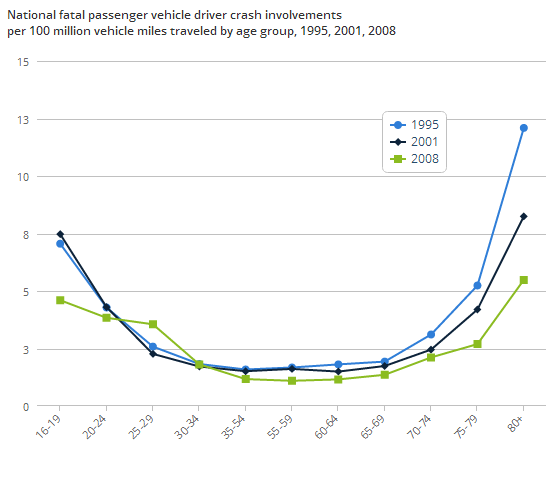
I would gather that the older someone is, the less likely they are to engage in risky behavior, correct? So long as one is operating a plane or car is a safe manner, they are accounting for reaction times, etc. *However*, if one does engage in risky behavior, reaction times quickly spell the difference between life and death. After 45, reaction times start reducing, by 80, they are nearly half of what they used to be. And yes, I'd say reaction times are important when flying upside down a few feet off the ground.

decrease%20of%20seniors%20involvment%20in%20crashes.png


The left side of the graph is higher because of risky behaviors, the left side is due to aging. An elderly stunt pilot combines the two sides of the graph.


One of the worst parts about this is that it looks potentially survivable, however, crews took about 5 minutes to arrive.
 
First off you need to do your homework. The source of that graph is here

http://www.iihs.org/iihs/sr/statusreport/article/49/1/1

The article, as well as most research, makes explicit that the frequency of accidents in older populations isn't higher and that we already know age does not have an influence on the frequency of primary car accidents. Your graph shows fatal vehicle crash involvement, and guess who tends to DIE more related to car accidents...older people. And I am not sure whether that graph is derived from fatality at the scene or fatality after hospitalization (and the time after hospitalization) because again...older people in a hospital are complicated especially given preexisting conditions.

So not only are you describing the conclusions of that graph incorrectly (the source disagrees with you, reaction time isn't even in that article...jesus dude...) you haven't even supported the proposition that reaction time differences based on age plays a role in an increased frequency of plane crashes (I suspect it could but on the whole...I'll be honest I researched automobile crash reports through NASS which has a rigid reporting style but aircraft crashes...I don't even know how those are investigated or assessed but I don't think they are able to investigate reaction time influence).

Again I posit that age is a smokescreen considering much more pressing factors of an airplane crash such as pilot error usually when a pilot misreads or ignores instrument readings and crashes into the terrain. They basically make a bad call and are avoidable but it ain't because of their reaction time differences. In the case of a stunt pilot they're making risky moves. Sure I bet reaction time matters a lot but as a function of age? I don't think there's any information that can support that theory. I know it's easy to think that it matters but dude...your reaction time isn't going to be the major factor. Pilot error (discretionary), inclement conditions, mechanical failure in that order. That's what you probably want to focus on.
 
In the video that RussDill linked to it looks like (to me) the engine is sputtering and misfiring with irregular pulses of flames coming out of the exhaust.

He flips the plane over and the engine is shooting flames and looks (again to me) like it just runs out of power and crashes into the ground.

Maybe that's just an effect of the oil on the exhaust for the smoke trail?

Sad whatever it turns out to be.
 
After 45, reaction times start reducing, by 80, they are nearly half of what they used to be. And yes, I'd say reaction times are important when flying upside down a few feet off the ground.

"Don't be a show-off. Never be too proud to turn back. There are old pilots and bold pilots, but no old, bold pilots."
- E. Hamilton Lee.
 
Noted aerobatic pilot Eddie Andreini died today at an airshow performance at Travis AFB in California. He was flying his Stearman, and the word on some aviation forums is that he was performing an inverted very-low-pass ribbon-cut trick (the plane flies close to the ground, upside down, and slices a vertically-stretched paper ribbon with its wing(s) as it passes). He was 77 years old - which, I feel, raises the rather uncomfortable question of just when is enough enough? I'm not saying someone who's 77 can't be a competent regular pilot; but we're not talking about normal flying.

Stunt flying at airshows is about the most dangerous type of flying there is. One is flying radical moves quite close to the ground in order to entertain the crowd, and unfortunately both younger and older pilots do get killed while doing so.

The one case that comes to my mind is with Nancy Lynn who was one of the best stunt pilots in the world. She was killed (when she was 50) at an airshow demonstration while her son was the DJ for the event.
 
Stunt flying at airshows is about the most dangerous type of flying there is.

That is an arguable point. I'd say that flying in combat with others trying to shoot you down is riskier. This type of airshow flying is certainly risky with lots of chance for miscues that is for certain...

I have no clue what caused this accident and neither does anyone else at this point. But, I can speak a bit about age effects on flying skills. There are several factors and not all affect everyone the same way at a specific age. So, I'm speaking in generalities here. Reaction time does decrease with age and that is very important in any type of precision flying. Little cues are not assimilated as rapidly and that can lead to cumulative disaster. Other things occur also. Visual acuity decreases and glasses don't solve all of the problem with this, particularly peripheral vision... G tolerance decreases, as well. These affects all combined have to increase the risk factors involved with this type of flying. There may be other factors, but these are the ones that immediately come to mind.

I don't know at what age all of these factors become significant and neither does the FAA. However, they generally begin to affect most everyone after the age of 40 and progress at different rates for different folks...

I seriously doubt this was a survivable accident for the pilot regardless of the crash response time. The Stearman is an open cockpit design and he landed UPSIDE DOWN on the tarmac and slid a long way grinding off the tail and top of the wings that might have prevented body contact with the ground surface.
 
That's not the uncomfortable question.

The uncomfortable question is this: Who decides?
In the USA it is the doctors as far as I know. All pilots (except ultralight and recreational) need physicals. While their pilot certificate never expires (2 yr flight review required for private pilots), medical certificates do. Over age 40 a pilot has to get a physical every 24 months to keep flying. http://en.wikipedia.org/wiki/Medical_certifications_for_pilots

Any real pilots here correct me if I'm wrong.

Ranb
 
Last edited:
While you are busy finding actual numbers to support the claim in your first sentence, I have a sneaking suspicion that you might find that most pilots are less than 77 years old. If that's the case, we should naturally expect that most pilot errors would be made by pilots less than 77 years old.
Since my sneaking suspicion coincides with yours, I'm happy to stipulate it. If that won't satisfy you, then I withdraw the claim in favor of asking newyorkguy to support his implication that pilot age is a significant factor in pilot error.
 
In the USA it is the doctors as far as I know. All pilots (except ultralight and recreational) need physicals. While their pilot certificate never expires (2 yr flight review required for private pilots), medical certificates do. Over age 40 a pilot has to get a phyical every 24 months to keep flying. http://en.wikipedia.org/wiki/Medical_certifications_for_pilots

Any real pilots here correct me if I'm wrong.

That seems pretty reasonable. I think it's interesting that the decision is made based on the pilot's measured physical competence, not the pilot's calendar age. Makes sense to me. I guess neither question was really that uncomfortable after all.
 
http://en.wikipedia.org/wiki/Medical_certifications_for_pilots

Any real pilots here correct me if I'm wrong.

Ranb

The wiki article is correct. While USAF flight physicals are quite rigorous and thorough, those performed by AME's are sometimes of a dubious nature. Some ATP holders go to the same AME for years and the exchange is something like
Dr - "how ya feeling"
ATP Holder - "I'm feeling fine, same as last time"
Dr - "Great, that will be XX$$, please".

Dr. usually does a perfunctory blood pressure check and listens to the heart beat. The one thing that keeps the First Class Physical honest is that an EKG is transmitted directly to the FAA Medical facility in OKC..
 

Back
Top Bottom